
Significant research funding awarded to the University of Vaasa – energy, healthcare and security examined from multiple perspectives
Image
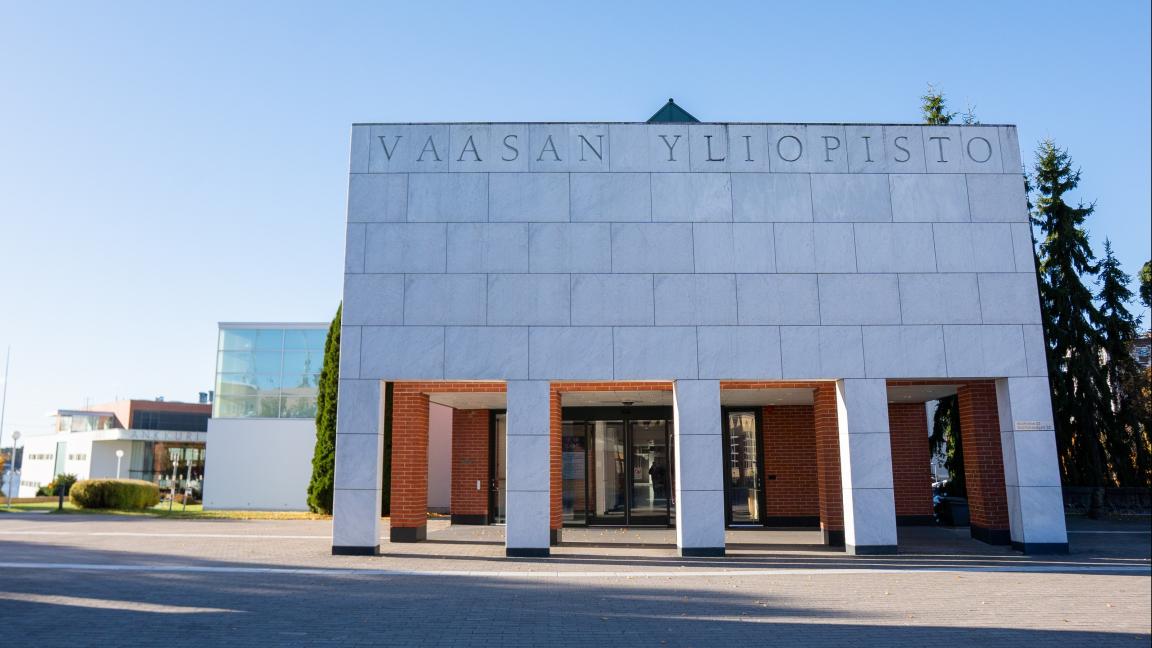


The University of Vaasa has received significant funding for five research projects. Three projects were funded by the Research Council of Finland and two by the Interreg Aurora programme. Altogether, the projects received approximately €2.12 million in funding.
Health care reforms examined through the lens of change
The Research Council of Finland–funded THRIVE project examines public sector reforms from the perspective of institutional change. The research explores how reform objectives are translated into effective strategies, practical actions, and everyday organisational practices.
The project studies health care reforms in Finland and five other countries. In Finland, case studies focus on the wellbeing services counties of Ostrobothnia, Pirkanmaa and North Savo.
– Finland’s health and social services reform provides a unique opportunity to examine a large-scale transformation of public administration in an international context. We study the mechanisms that explain success and how such reforms can be effectively organised, says Associate Professor Anna-Aurora Kork.
At the University of Vaasa, sub-projects approach the reforms from two perspectives. The sub-project led by Kork focuses on impact management, that is, how health care reforms are expected to generate societal impact and how they are justified in different countries. The sub-project led by Associate Professor Lotta-Maria Sinervo examines implementation, particularly from the perspective of resources.
– We analyse how financial, human and institutional resources enable or constrain the implementation of reforms. This understanding is essential for ensuring that reforms can be carried out in a sustainable and impactful way, says Sinervo.
The project is led by the University of Eastern Finland in collaboration with the University of Vaasa and university partners in New Zealand, Canada, the United Kingdom, Italy, Denmark and Norway. The total funding allocated to the University of Vaasa is approximately €670,000.
Hydrogen economy requires functioning markets and structures
Another project funded by the Research Council of Finland, H2Nexus, examines the transformation of energy systems and, in particular, what is required to build a sustainable hydrogen economy in Finland. The project focuses on how markets and energy ecosystems develop as the hydrogen economy advances.
The project combines techno-economic modelling with market and social science analysis. It explores topics such as business models, pricing mechanisms and ecosystem governance.
– We study how hydrogen markets are formed and what factors enable or hinder their development. This helps us understand how the transition can be guided in a sustainable way, says Professor Rodrigo Rabetino.
Clean hydrogen is seen as a key solution particularly for reducing emissions in sectors that are difficult to decarbonise. At the same time, the development of a hydrogen economy is complex, involving factors such as market formation, regulation, infrastructure and business viability. The project produces new knowledge on hydrogen market development from both business and energy system perspectives and supports decision-making, investments and the development of practical solutions for companies in the emerging hydrogen economy.
The University of Vaasa coordinates the project and is responsible in particular for research related to markets and business. VTT Technical Research Centre of Finland leads the techno-economic and energy system modelling. The University of Vaasa received €497,959 in funding for the project from the Research Council of Finland.
The role of the legal system examined in the sustainability transition
The Strategic Research Council (SRC) operating in connection with the Research Council of Finland has granted continuation funding for the RELIEF project, which examines the role of the legal system in the sustainability transition.
– We study how ambitious climate and environmental goals can be advanced in a fair way while safeguarding the core principles of the legal system, such as democratic decision-making, the division of responsibilities between the public and private sectors, and well-functioning markets, says Professor Harri Jalonen.
The project examines, among other things, the roles of public authorities and private actors and develops methods for assessing regulatory frameworks and the impacts of different stakeholders. The research is closely linked to ongoing legislative and strategic processes as well as to practical solutions developed by companies and other actors.
The University of Vaasa received €404,446 in continuation funding for the project.
Digital solutions for low-emission maritime transport
The University of Vaasa also received funding for two Interreg Aurora projects that strengthen cross-border cooperation in the Kvarken region.
The KVARCO project develops digital solutions to improve the sustainability, energy efficiency and climate resilience of maritime transport between Finland and Sweden. It focuses in particular on the Vaasa–Umeå connection, a key transport and logistics corridor in the Gulf of Bothnia.
The project combines vessel operational data, environmental observations and advanced analytics. It examines how factors such as weather conditions, sea ice dynamics and other environmental changes affect vessel performance, energy consumption and emissions. Based on this, practical tools are developed, including an emission reporting dashboard for SMEs to help meet growing EU sustainability requirements.
– KVARCO uniquely combines operational vessel data, environmental observations and digital solutions. The aim is to develop practical tools that simultaneously improve efficiency and reduce emissions in challenging northern conditions, says Project Researcher Vaiva Stanisauskaite, who serves as the project manager and coordinator.
The University of Vaasa acts as the project coordinator. The total budget is €1.28 million, of which approximately €437,000 is allocated to the University of Vaasa. The consortium also includes Umeå University, the Finnish Meteorological Institute and the Kvarken Council.
Strengthening municipal preparedness through cross-border cooperation
The Secure Kvarken project focuses on improving security, resilience and preparedness at the municipal level in the Kvarken region. The aim is to create a new, long-term model for cooperation between municipalities in Finland and Sweden in situations where normal societal functions are disrupted.
The project compares national preparedness systems, governance structures and the roles of municipalities in a changing security environment. Particular attention is given to civil protection, evacuation arrangements, cyber security and crisis communication. At the same time, best practices are identified and new operational models developed to support municipal cooperation.
– Municipalities play a key role in everyday security, but there is a clear need for cross-border cooperation structures. In this project, we are developing practical models and tools that help municipalities prepare for disruptions together and support each other across borders, says Urho Lintinen, project manager and responsible researcher.
The project makes use of digital tools and simulations to support training in crisis management and decision-making. It also examines how residents’ experiences and knowledge can be incorporated into situational awareness and how trust in society can be strengthened.
– Security is not built solely on structures or systems, but also on people, cooperation, trust and shared information. Secure Kvarken brings together research, authorities and municipalities to build long-term resilience in the Kvarken region, says Research Director Petri Uusikylä.
The project aims to produce concrete tools, such as a shared roadmap and practical handbooks, to help municipalities improve their preparedness and strengthen cross-border cooperation.
The consortium includes the University of Vaasa, the Regional Council of South Ostrobothnia, the Regional Council of Ostrobothnia, Seinäjoki University of Applied Sciences, Länsstyrelsen Västernorrland, Region Västerbotten and Mid Sweden University. The total project budget is €1,538,546, of which approximately €118,645 is allocated to the University of Vaasa.