
Hitachi Energy and the University of Vaasa begin research collaboration – Optimising transformer efficiency and recovering heat to improve the en-ergy and cost efficiency of hydrogen production
Image
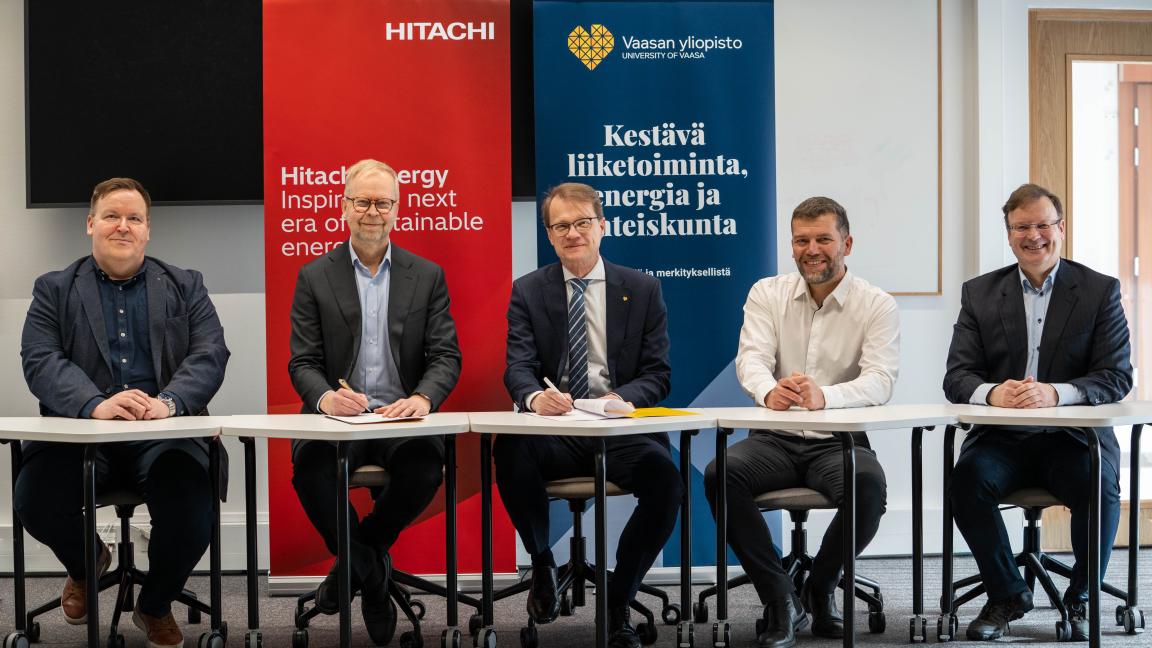
Pictured from Hitachi Energy Oy are Toni Koskinen, Head of the Transformer Business, and CEO Matti Vaattovaara, together with the University of Vaasa’s Vice‑Rector Mika Grundström, Professor Maciej Mikulski and Dean Raine Hermans


Hitachi Energy and the University of Vaasa have signed an agreement on research collaboration aimed at developing transformer efficiency and heat recovery to improve the energy and cost efficiency of hy-drogen production.
Electricity is the most important raw material in hydrogen production and the foundation of the entire production process. The electrolyser, together with the required rectifiers, rectifier transformers and power supply system, forms an electrical entity that constitutes the core of green hydrogen production. When the power supply and rectifier transformers are properly designed, electrolysis operates reliably, efficiently and in a grid-friendly manner.
Electricity accounts for around 70 percent of a hydrogen plant’s operating costs. With current technologies, roughly one-third of the electricity supplied to a hydrogen plant is lost as heat and electrical losses. This share can be significantly reduced through careful design of the electrification system and by utilising waste heat from transformers, rectifiers, electrolysers and compressors.
The goal of the research project Optimized Electric Power Chain for Electrolyser Systems (OEPCES) is to improve the efficiency of transformers – and thus the entire system – by capturing waste heat and using it either for district heating or in the hydrogen plant’s own processes.
The rectifier transformers used in hydrogen plant electrical systems are high‑technology special transformers that supply electricity to rectifiers, which convert alternating current (AC) into direct current (DC) for electrolysis. From a power supply perspective, electrolysis has a very demanding load profile. The transformer needs to deal with high peak power demand, with rapid power transients, under stringent power quality requirements requiring active integration with the electrical grid. This creates a very challenging constraints for optimizing the efficiency and operating range of the rectifier.
At present, the heat generated in the power supply and transformers is removed through cooling systems and not utilised in hydrogen plant processes. The first phase of the project will focus on developing the electro-thermal model of transformers – to enable efficiency optimization of the device and it’s integration with waste heat recovery system.
– In industrial-scale green hydrogen production, electrolysis and its associated power supply represent rapidly developing new technology, and we want to be at the forefront of this development. We are delighted to have the University of Vaasa joining us in developing world-class solutions that improve energy efficiency, reduce costs and accelerate the adoption of clean energy. This development work marks a concrete step toward more sustainable and competitive hydrogen production, says Matti Vaattovaara, Managing Director of Hitachi Energy.
– The energy transition and the new opportunities it brings across different sectors make research projects more important than ever and are essential for understanding the overall system. Modelling and the ability to reliably analyse complex systems and explore alternative models are key objectives that enable the creation of new knowledge and the development of competitive solutions to these emerging needs. Green hydrogen production and the new solutions related to it are a central part of systems research, where the multidisciplinary expertise of the University of Vaasa’s research groups can be fully utilised, says Mika Grundström, Vice-Rector for Research at the University of Vaasa.
OEPCES is carried out as part of the HEROES (Heat and Energy Recovery Of Electrolyser Systems) research and development project by VTT and the University of Vaasa. The aim of the project is to revolutionise the energy efficiency of hydrogen production by fully utilising waste heat from electrolyser systems. The main goal of the HEROES project is to develop and demonstrate a hydrogen production system that can reduce electricity consumption by up to 35 percent and increase net efficiency to as much as 85 percent, whereas current systems typically range between 50 and 70 percent. The project directly supports the climate and hydrogen strategies of Finland and the EU, as well as the emergence of new low‑carbon industry. The OEPCES project includes the Efficient Powertrain Solutions (EPS) research group from the University of Vaasa.
Hitachi Energy acts as a partner from the investment phase to the implementation and maintenance of the hydrogen plant’s electrical system, covering pre‑engineering, execution, management and lifecycle optimisation of the power system. The company has delivered the main electrical system for Finland’s first industrial‑scale hydrogen production plant, built for P2X Solutions in Harjavalta.
Tietolaatikko
Further information
Professor Maciej Mikulski, Efficient Powertrain Solutions (UVA), School of Technology and Innovation, University of Vaasa, tel. +358 29 449 8591, maciej.mikulski@uwasa.fi