
Writing Guidelines
The writing guidelines of the University of Vaasa do not apply to doctoral theses.
An accessible version of the writing guidelines is available in Word format.
The guidelines provide information about thesis layout, the use of references, and finalizing the text. These guidelines are also applied to other written work from the beginning of your studies. This way, you will become familiar with the writing guidelines before starting your thesis. Please note that the writing guidelines do not cover all possible situations. In uncertain cases, you should consult your thesis supervisor for advice.
(updated August 11, 2026)
(updated June 13, 2025)
Please note that, regardless of the template, you are responsible for ensuring that the writing guidelines are correctly applied in your work.
- Overleaf (updated 2.5.2022) LaTeX template that you can use for your own project.
- Office support | Easy-to-use Make your Word documents easy-to-use for disabled users.
Language Centre Linginno is responsible for maintaining the writing guidelines of the University of Vaasa.
Title page
The title page uses the Calibri font, with single line spacing.
1. The University of Vaasa logo is centred at the top of the page.
2. The author’s name, in font size 16, is centre-aligned, in the middle of the page.
3. Below the name, the bold main title is written in font size 20. The title may consist of two parts, in which case it is divided into a main title and a subheading. If there is a subheading, it is written in font size 14.
4. On the right-hand side of the title page, information about the type of work is provided, in font size 12.
5. The final line at the bottom of the page gives the university’s location, centre-aligned: Vaasa 20XX (font size 12). The year given is the year the thesis has been approved.

Abstract
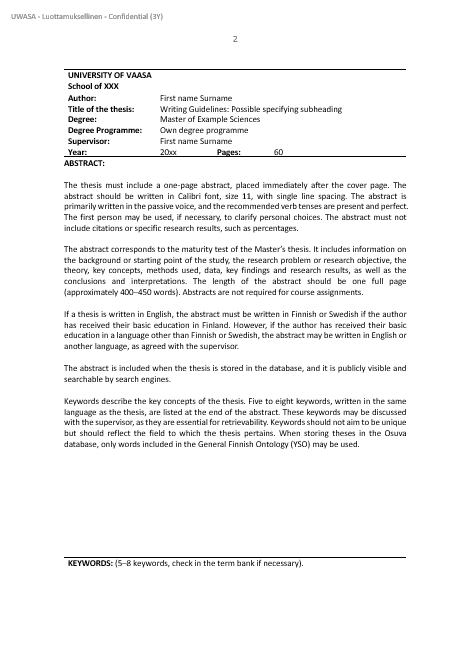
The thesis must include a one-page abstract, placed immediately after the cover page. Abstracts are not required for course assignments. The abstract page begins with background information about the work and its author.
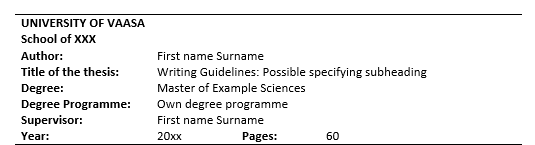
- The abstract should be written in Calibri font, size 11, with single line spacing.
- The abstract is primarily written in the passive voice, and the recommended verb tenses are present and perfect. The first person may be used, if necessary, to clarify personal choices.
- The abstract must not include citations or specific research results, such as percentages.
- The abstract corresponds to the maturity test of the Master’s thesis. It includes information on the background or starting point of the study, the research problem or research objective, the theory, key concepts, methods used, data, key findings and research results, as well as the conclusions and interpretations.
- The length of the abstract should be one full page (approximately 400–450 words).
- If a thesis is written in English, the abstract must be written in Finnish or Swedish if the author has received their basic education in Finland. However, if the author has received their basic education in a language other than Finnish or Swedish, the abstract may be written in English or another language, as agreed with the supervisor.
- Keywords describe the key concepts of the thesis. Five to eight keywords, written in the same language as the thesis, are listed at the end of the abstract. These keywords may be discussed with the supervisor.
Page numbers and contents table
Page numbers
- After the title page, all pages are numbered sequentially, with the abstract on page two, and after it the contents table. If there is no abstract page, the contents table begins immediately after the title page, on page 2.
- Page numbering continues through to the last page of the appendices, at the end of the study.
- The page number is centred 1.5 cm from the top of the page, using Calibri font in size 11.
Contents table
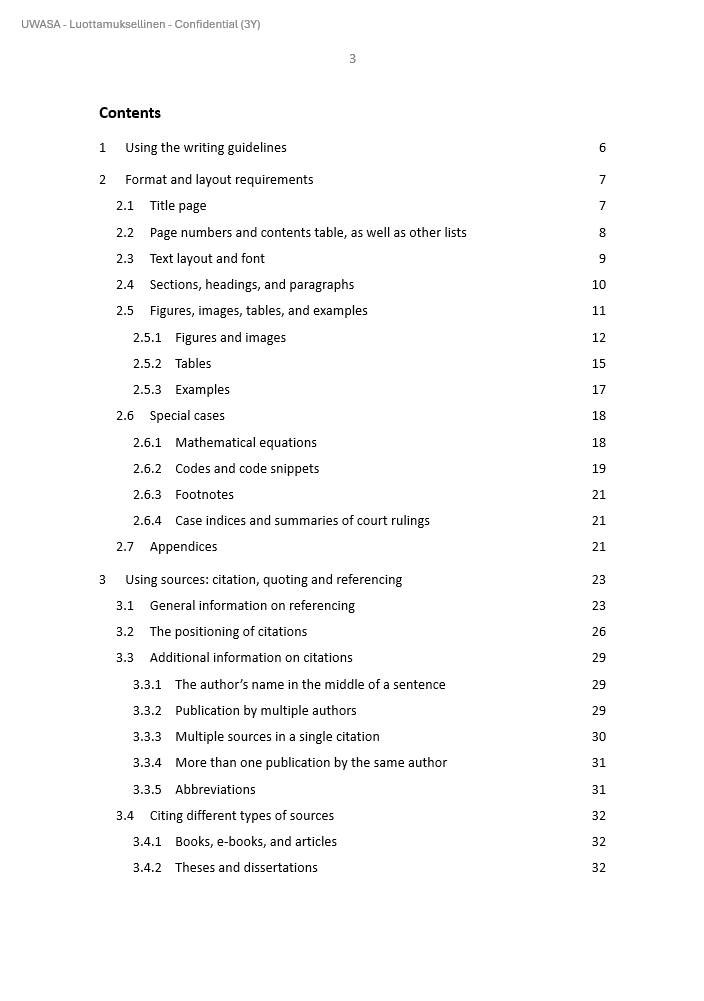
- The contents table is titled Contents.
- The line spacing is 1.5.
- In the contents table, the content of the study is divided and organised by title and page number, following the sequential order of the thesis.
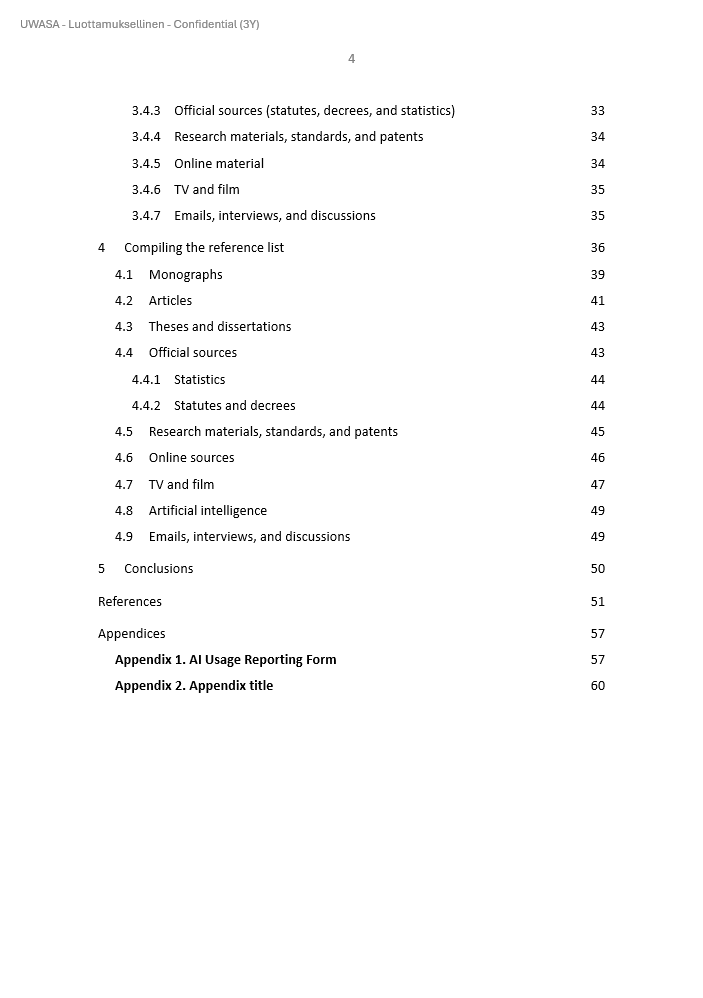
- Subheadings are indented so that Level 2 headings are indented 0.5 cm from the left margin and Level 3 subsection headings are 1 cm from the left margin.
- The references section is placed at the end of the contents table, followed by any other lists.
- In the contents table, the words References and Appendices are not preceded by a number. If there is one appendix, it is featured in the contents table as follows: Appendix. Appendix title. If there are several, they are numbered consecutively.
- Dotted lines are not used between headings and page numbers in the contents table.
- The abstract page is not included in the contents table.
Lists
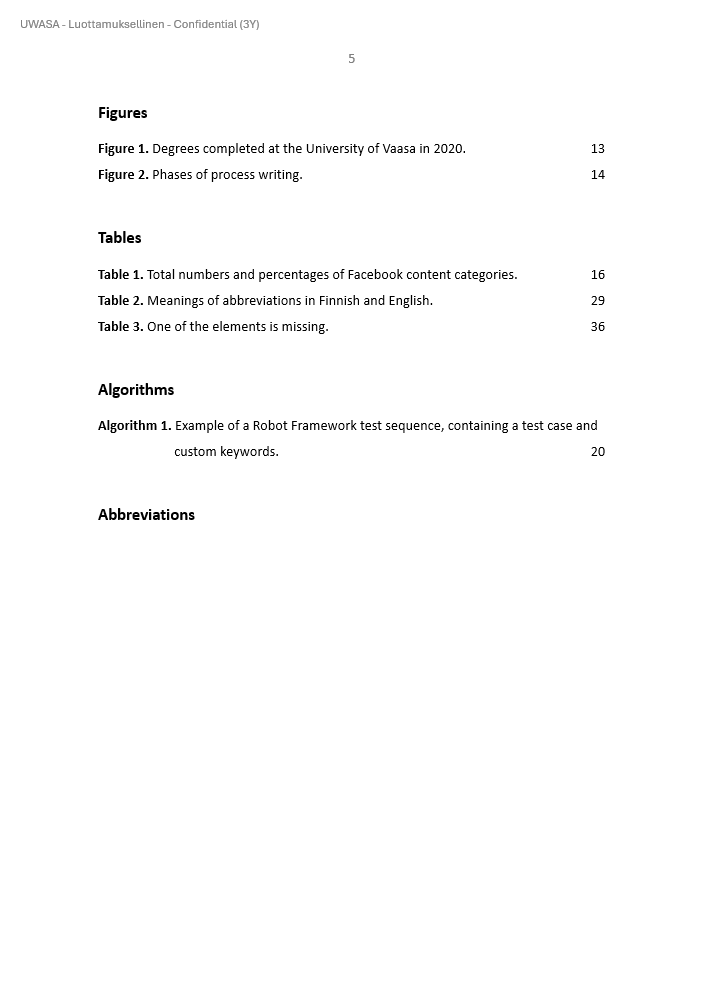
- Lists of images, figures, tables, symbols, terms, and abbreviations are placed on a separate page after the contents table
- Images, figures, and tables are listed one below the other, by title and page number.
- The titles of the lists are in font size 14 and emboldened.
- The list does not include any sources.
- If there are no more than three images, figures, or tables, a separate list is not necessarily needed.
- Signs, abbreviations, symbols, and terms that the reader is unlikely to be familiar with are listed with explanations, and grouped in alphabetical order: for example, first the Greek alphabet, then the Roman alphabet, and finally the abbreviations.
- The list of abbreviations is titled Abbreviations and includes established, regulatory, and other abbreviations used in the study.
- For statutes, the full name is written together with the number. The list of abbreviations only includes cases where an actual abbreviation has been used. For example, a statute is not included in the list of abbreviations, unless an abbreviation is used when referring to it.
- When a list of abbreviations is used, the abbreviations do not need to be explained in the text.
- If there are only a few abbreviations, consider writing the full concept when first referring to it in the text, instead of creating a list of abbreviations.
Text layout and font
Text layout
- The text is positioned so that the left, right, top, and bottom margins are all 3 cm.
- Both edges of the text must be justified.
- All written papers should use 1.5 line spacing.
- Single line spacing is used in the abstract, code, or in direct quotations longer than three lines. Single line spacing is also used for table, image, and figure captions, examples, and footnotes.
- In the reference list, the line spacing should be 1.5.
- Lastly, no lines of text should be left standing alone at the top or bottom of a page (commonly referred to as orphan lines).
- The entire document should be automatically hyphenated.
- No blank pages should be included.
Font
- The body of the thesis is written in Calibri font, size 12.
- Bold and italic styles are used in accordance with the supervisor’s instructions. Italics are often used to indicate the substance of the language (e.g., the word word contains four letters). For the sake of accessibility, bold is preferable to italics.
- Underlining text is not recommended, as it is often associated with hyperlinks.
- Colours may be used, but they should not be the sole means of conveying information.
- Emphasis techniques should be used sparingly and must be applied consistently when used.
Sections, headings, and paragraphs
- The text is divided into sections, each of which is titled and numbered.
- By using word processor styles, the file can be made accessible. Merely formatting the headings by manually adjusting the layout is not permitted.
- All headings are in bold font and are preceded by two blank lines.
- After the heading, there is always one blank line before the text.
Main sections
- Main section headings are written in bold, and font size 16.
- All main sections (1) of the thesis begin on a new page. In other written works, the section headings are separated from the preceding text by two blank lines.
Subsections
- Subsections continue on the same page as the preceding text.
- Level 2 headings (1.1) are written in bold, and font size 14.
- There must be at least two subsections.
- The headings of all Level 2 subsections are separated from the preceding text by two blank lines. If a Level 2 subsection follows the main section headings, one blank line between the headings is sufficient.
- However, in theses, it is recommended to include introductory text between the main section and the subsection.
Level 3 and Level 4 subsections
- Level 3 and 4 headings are written in font size 12.
- There must be at least two subsections.
- Level 3 and 4 subsections are separated from the preceding heading or text by two blank lines.
- A maximum of three levels (1.1.1) is recommended. A Level 4 heading may be used if necessary for clarity, and its layout should correspond to Level 3 headings.
Division into paragraphs
- The text is divided into paragraphs, with each one separated by a single blank line.
Figures
The use of figures
- Figures can be used to illustrate and simplify the topic that is presented.
- Figures complement the text. Their content must be sufficiently detailed so that they can be viewed and understood without dependence on the main text.
- Figures must be clearly visible and appropriately sized. For instance, they should not contain unnecessary blank space and must fit within the set margins and on a single page.
- Figures must either be the author’s own or include the original source title and a reference. The source reference should be formatted according to the guidelines (author, year, and, if necessary, page number). For all figures, including those translated by the author, the original source must always be cited.
- In some cases, only a part of a figure or table has been borrowed in part, in which case a reference is also made to the original source. In these cases, the text must clearly indicate what the author's own contribution is and what is borrowed from the original source. If the figure has been modified, the source is marked (adapted from…).
The layout of figures
- Figures are separated from the body text by a single line break (with 0-point spacing in Word) both above and below.
- The title of the figure, i.e., the caption, is written below it and ends with a full stop. Any source references are included in parentheses after the caption. In this case, the caption ends with the full stop after the source reference.
- The text Figure 1. is in bold, but the caption itself is not.
- The font used is Calibri, size 11, with single line spacing
- If the caption continues onto a second line, it should be indented to align with the first line.
- Every figure should be referred to at least once in the body text. Figures must be adequately explained in the text.
- Captions must be given.
- Figures must include alternative text, known as alt text. The alternative text must provide the information that would be lost to the reader if the figure or image were not visible.
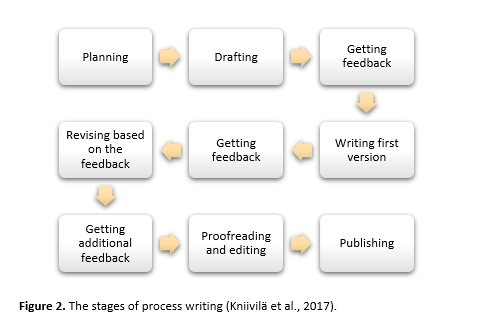
- When designing figures, one should keep in mind that even a small symbol can have a significant impact. For example, the direction in which an arrow points can crucially alter the content and meaning of the figure, as shown in Figure 2.
- Any technical drawings or diagrams must use standardised and quantity symbols.
- Figures can also be presented in appendices.
- If a figure has been created or edited using AI, the prompt used and information about the use of AI must be included in the figure caption. See the example on page 15 of the Writing Guidelines Word document.
- The use of AI must be reported in accordance with Appendix 1 of the Writing Guidelines Word document.
Images
The use of images
- Images, such as photographs or screenshots, should only be used in the thesis if they are necessary to the purpose and method of the research.
- The use of an image is justified when it clarifies or illustrates the thesis author’s own work.
- When using images, the copyright of the images must be considered. Photographs are likely to exceed the so-called work threshold, meaning permission to use them must be obtained from the creator. If the creator has transferred their rights to another party, such as a publisher or producer, permission to use the work must be sought from them. Permission should be requested at the beginning of the thesis writing process, so that any potential restrictions on the use of images can be considered when planning the research.
- In academic writing, images can, to some extent, be used without permission under the fair use principle. Fair use allows for excerpts from published works to be used for academic purposes when the image is closely related to the subject being discussed.
- Merely decorative images may not be used.
- The source reference for the image should include the name of the publication or photographer.
If a figure or image has been created or edited using AI, a statement indicating that AI has been used, including the prompt utilised, should be included in the caption beneath the figure or image, as demonstrated in the example below.
Image 1. The future advertisement for Finland’s most popular coffee. NB: The image was created using AI, with the prompt: “Create an advertisement for Finland’s most popular coffee in 2045” (OpenAI, 2023).
The source is included in the reference list, and the citation includes the model creator, company, or publisher, and the date (see Section 4.8).
The layout of images
- Images must be clearly visible and appropriately sized. For instance, they should not contain unnecessary blank space and must fit within the set margins and on a single page.
- Images are separated from the body text by a single line break (with 0-point spacing in Word) both above and below.
- The title of the image, i.e., the caption, is written below it and ends with a full stop. Any source references are included in parentheses after the caption. In this case, the caption ends with the full stop after the source reference.
- The text Image 1. is in bold, but the caption itself is not.
- The font used is Calibri, size 11, with single line spacing.
- If the caption continues onto a second line, it should be indented to align with the first line.
- Captions must be given.
- Every image should be referred to at least once in the body text. Images must be adequately explained in the text.
- Images must include alternative text, known as alt text. The alternative text must provide the information that would be lost to the reader if the image were not visible.
- Images can also be presented in appendices.
- If an image has been created or edited using AI, the prompt used and information about the use of AI must be included in the figure caption. See the example on page 15 of the Writing Guidelines Word document.
- The use of AI must be reported in accordance with Appendix 1 of the Writing Guidelines Word document.
Tables
The use of tables
- Tables are often used to present statistical data. Statistical data are presented in a separate table, either within the text or as an appendix. If there is only a small amount of numerical data, it can also be presented in untitled and unnumbered formats.
- A table consists of rows and columns, in which the data are presented in a simplified manner.
- The same information must not be presented both as a table and a figure.
- A reference to the original source is required even in cases where only part of a figure or table has been borrowed. In these instances, the text must clearly indicate what the author’s own contribution is and what has been borrowed from the original source. If a table has been modified, the source should be marked as (adapted from...).
The layout of tables
- The body text must include a mention of each table, either before or after the table is presented.
- The tables must be clear in appearance and appropriate in size.
- The tables should not have unnecessary blank space and must fit within the set margins, ideally on a single page.
- The header row of the table must be clearly indicated.
- Tables are separated from the body text by one blank line above the table caption and one below the table.
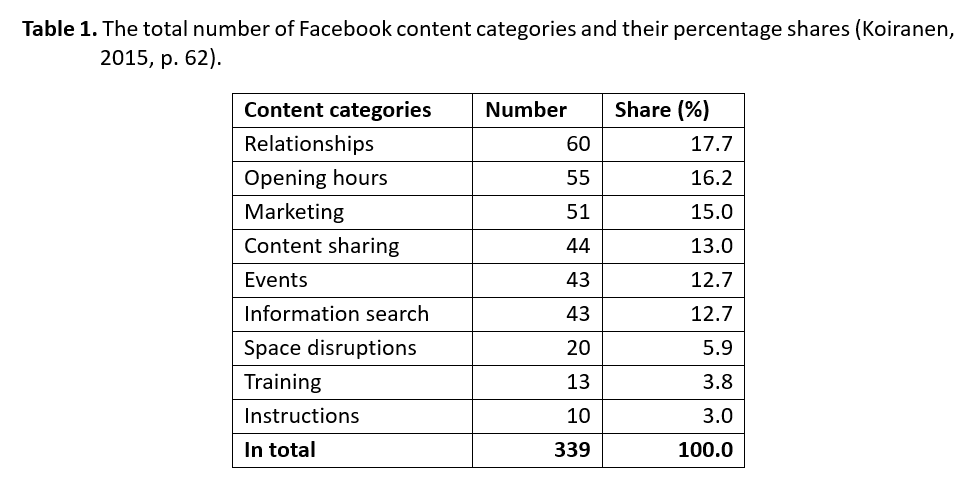
- The table caption is written above the table and ends with a full stop. When source references are provided, they are enclosed in parentheses after the table caption, and the caption ends with a full stop after the reference. If a table caption continues onto a second line, this should be indented to align with the text on the first line. If the table has been created or edited using AI, a statement indicating that AI has been used, including the prompt that was utilised, should be included in the table caption above the table (see the example in Section 2.5.1).
- The font is Calibri, size 11, with single line spacing.
- The text Table 1. is in bold, but the caption itself is not.
- To optimise visual accessibility, the header row should be clearly indicated. Once the table has been created, the top row of the table should be marked as the header as follows: Place the cursor on the top row of the table to display the Table Tools on the Word command line. From the Table Tools, select “Layout” and then select “Repeat Header Rows”. This will ensure the header row of the table is repeated, even if the table spans several pages.
- Tables must include alternative text, known as alt text. The alternative text must provide the information that would be lost to the reader if the table were not visible.
- The font of the table should match the font of the body text, and depending on the size of the table, the font size can be either the same or smaller than that of the text.
- The layout of all tables used in the document should be consistent, and excessive embellishment should be avoided. Tables should not be used merely to enhance the visual appearance of the text.
- Each table should be explained sufficiently in the body text.
- Tables can also be presented in appendices.
- If a table has been created or edited using AI, the prompt used and information about the use of AI must be included in the table caption above the table. See the example on page 15 of the Writing Guidelines Word document.
- The use of AI must be reported in accordance with Appendix 1 of the Writing Guidelines Word document.
Examples
- All examples from the research material that are given must be numbered consecutively, as illustrated in the following example.
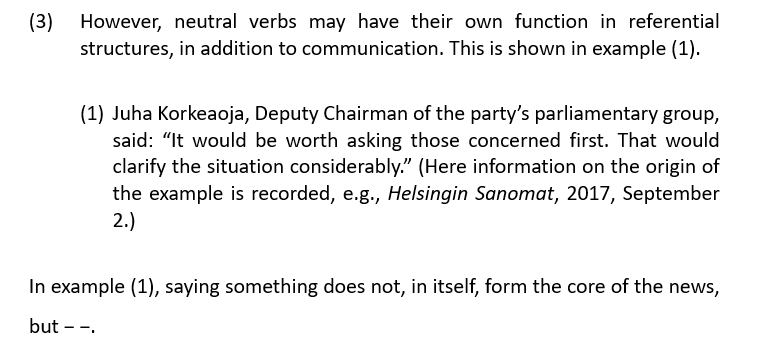
- The examples must be distinguished from the rest of the text by indentation (1.5 cm for the example number, 2.5 cm for the example text) and single line spacing. A more precise example of the spacing can be found on page 17 of the writing guidelines.
- Usually, there is text following an example, so it should not be the last part of a section.
- All examples must be referenced in the text and adequately explained. The interpretation of the examples should not be left to the reader.
- Examples are not enclosed in quotation marks and are not italicised.
Special cases
Special cases concern, in particular, the fields of technology and law.
Mathematical equations
- Mathematical equations should be numbered consecutively and integrated into the text, following standard punctuation rules, including the use of commas.
- Each equation should be written on its own line and separated from the surrounding text by one blank line before and after.
- The sequential number of the equation is written in parentheses to the right, and the equation itself should be indented so that the equation part of all equations starts at the same point. This is illustrated in the image below.
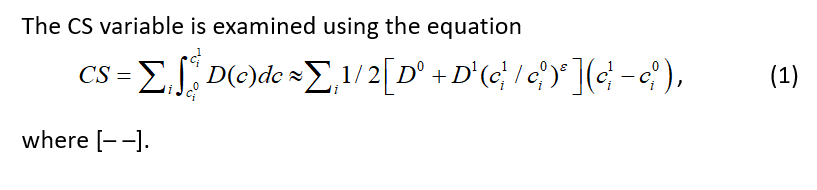
- The actual variable is introduced first, and the comma preceding the subordinate clause is placed at the end of the equation.
- The quantities in the equation should only be explained in connection with the equation if they have not already been explained in the text or in other equations.
- If the sentence does not continue after the equation, a full stop should be placed at the end of the equation. In this case, any source reference should be placed at the end of the text preceding the equation.
- A more detailed model for the settings can be found on page 18 of the writing guidelines.
Standardised representations
In mathematical representation, standardised signs and symbols must be used wherever they exist. Standards can be found in the following publications, for example:
SFS-ISO 1000 + A1 (1999). SI units and recommendations for the use of their multiples and of certain other units
SFS-ISO 31-0 + A1 (1999). Quantities and units. Part 0: General principles
SFS-ISO 31-11 (1999). Quantities and units. Part 11: Mathematical signs and symbols for use in the physical sciences and technology.- In the absence of standardised symbols, other established signs should be used, and as a last resort, symbols created by the author may be utilised.
Codes and code snippets
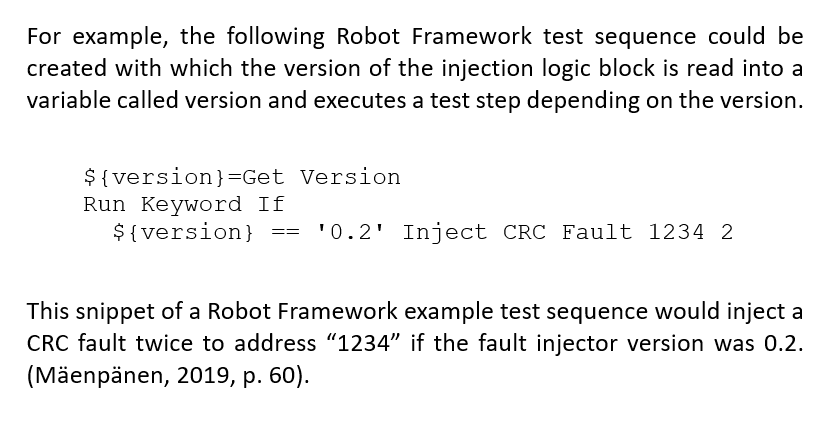
- The code or code snippet should be indented and separated from the rest of the text by one blank line before and after.
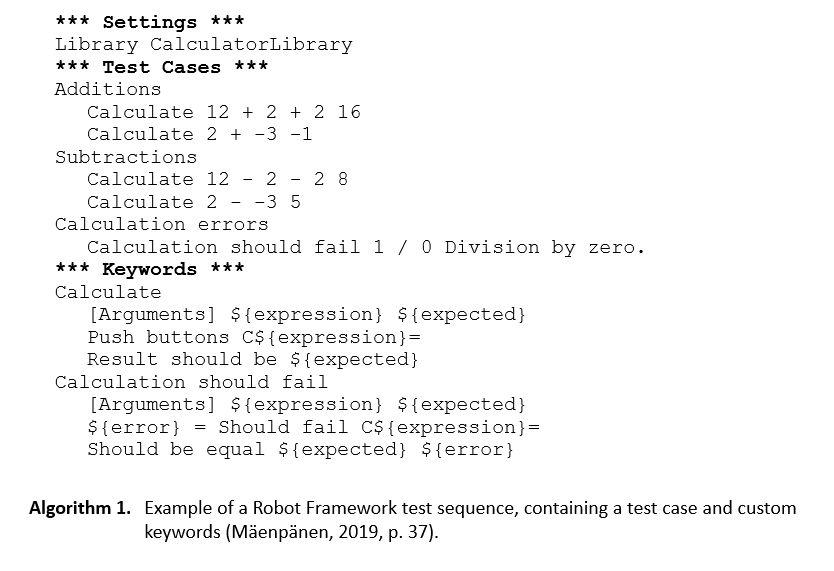
- The font used should be a monospaced font, such as Courier, except for pseudocode examples, where it is recommended to use a proportional font.
- If a code snippet is fewer than ten lines, there is no need to create a title or list, as shown in the image below.
- If there are ten lines or more, they should be treated as images or figures, that is, they are labelled Algorithm 1. or Code 1., as shown in Algorithm 1.
- If the code has been created or edited using AI, the prompt used and information about the use of AI must be included in the explanatory text below the code. See the example on page 15 of the Writing Guidelines Word document.
- The use of AI must be reported in accordance with Appendix 1 of the Writing Guidelines Word document.
- Further details on specific guidelines in the field of technology is available from the thesis supervisor.
Footnotes
- In public law, only regulations are referenced using parenthetical citations, while all other sources are marked with footnotes. In business law, regulations can be cited either using footnotes or in-text citations according to the APA style. The chosen method of referencing should be applied consistently throughout the thesis.
- When using footnotes, the number should be placed before the full stop. The font size for footnotes is 10, and the line spacing is single.
- Thesis writers in the field of law should observe the established citation practices of their discipline. It is advisable to discuss these with a supervisor before beginning the thesis.
Appendices
- Any appendices included are placed after the reference list.
- They should be titled, numbered consecutively, given page numbers, and listed in the contents table.
- Examples of appendices include questionnaires or interview forms used, other correspondence related to data collection, and possible examples of the data. The entire data set should never be included as an appendix.
- Appendices can also include figures and tables that illustrate the content of the thesis but are too large to be placed within the body text.
Using sources: citation
- The use of references is part of good academic practice.
- References provide information about the source material used in the study and indicate how it has been applied.
- References make it possible to verify the content of the text and show when the author is relying on the work of another researcher.
- All sources used should be easily located in the reference list.
- By providing appropriate citation and referencing, the student demonstrates their adherence to established academic practice, as a specialist in their field.
- When citing sources, a distinction is made between paraphrasing and direct quotation.
- Paraphrasing means that the key idea relevant to the research framework is expressed in the author’s own words.
- The writing guidelines of the University of Vaasa apply the style guidelines of the American Psychological Association (7th edition).
In-text citations are used for referencing, meaning that references are placed within the body of the text. In-text citations are formatted either as parenthetical citations or narrative citations.
Parenthetical citations
- In a parenthetical citation, the following information is placed in parentheses: author, comma, space, date, comma, space, p. (for a single page) or pp. (for multiple pages), space, and the specific page(s) used.
- In parenthetical citations, the ampersand (&) is used within the parentheses, while the word and is used in the body text. If the source has three or more authors (more than two), only the first author’s surname is given in the text and parentheses, followed by “et al.”.
Text text text text (Saleem & Larimo, 2016, p. 248).
Text text text text (Koskela, 2003, p. 22).
Text text text text (Kniivilä et al., 2017, p.54).
- The exact pages referenced should be included in the parentheses. Pages are separated by an en dash (–), which is longer than a regular hyphen. When citing an entire work, page numbers are not necessary. Instead of a page number, the citation may include a chapter number or title, slide number, video timestamp, or other similar details.
Text text text text (Koskela, 2003, pp. 222–224).
Text text text text (Saleem & Larimo, 2016, chapter 3).
- Sometimes not all source reference information is available. If no date can be found, such as for a website, the abbreviation n.d. is used. This abbreviation n.d. should be marked in both the citation and the reference list.
Text text text text (Tiainen, n.d., p. 2).
Narrative citations
- In a narrative citation, only the date and page(s) are placed in parentheses.
- In a narrative reference, the ampersand (&) is not used, but instead the word and is used.
According to Koskela (2003, pp. 222–224) [– –].
According to Saleem and Larimo (2016, chapter 3) [– –].
According to Kniivilä et al. (2017, p. 54) [– –].
Koskela (2003, p. 227) discusses [– –].
Saleem and Larimo (2016, p. 248) state that [– –].
Kniivilä et al. (2017, p. 78) define [– –].
- The exact pages referenced should be included in the parentheses. Pages are separated by an en dash (–), which is longer than a regular hyphen. When citing an entire work, page numbers are not necessary. Instead of a page number, the citation may include a chapter number or title, slide number, video timestamp, or other similar details.
According to Koskela (2003, pp. 222–224) [– –]
According to Saleem and Larimo (2016, chapter 3) [– –].
- In narrative citations, various reporting verbs, such as claim, state, present, and discuss, can be used.
Tiainen (n.d., p. 2) states that [– –].
Using sources: quoting
- In direct quotations, the source is cited exactly as it appears in the original text.
- Direct quotations must always include the page number of the source.
- Direct quotations are enclosed in quotation marks if they are at least three words long but no more than three lines.
- A short quotation is distinguished from the surrounding text using quotation marks.
- Quotations longer than three lines, often called block quotations, are written with single line spacing, indented (1.5 cm), and without quotation marks. However, long direct quotations should be avoided.
Luukka (1995) describes an approach to community in accordance with social constructionism:
Community members share similar values, beliefs, and practices that lead to, for example, common ways of speaking and norms. Management of these practices is a precondition for belonging to the community. Practices exist and emerge in the community and at the same time also shape the community. The community is therefore seen above all as a normative force. The interpretation of the text is canonical and the discourse normal if it follows community norms. (pp. 57–58)
OR
The approach to communality under social constructionism is described, for example, as follows:
Community members share similar values, beliefs, and practices that lead to, for example, common ways of speaking and norms. Mastering these practices is a precondition for belonging to the community. Practices live and emerge in the community and at the same time also shape the community. The community is therefore seen above all as a normative force. The interpretation of the text is canonical and the discourse normal if it follows community norms. (Luukka, 1995, pp. 57–58)
Using sources: secondary sources
- The source that was actually used should be cited.
- The general principle is that students should use primary, that is, original sources.
- If a secondary source, also known as a second-hand source, is used, its secondary nature must be clearly indicated in the text.
- If the publication year of the original source is known, it should also be indicated in the in-text citation.
Freud (1900/1965, as cited in Sugarman, 2010, Chapter 2, The Pleasure Principle) theorizes about the reality principle serving the pleasure principle.
The reality principle can be understood as underlying the reproduction of a state of satisfaction (Freud, 1900/1965, as cited in Sugarman, 2010, Chapter 2, The Pleasure Principle).
- Only the source that has been directly consulted should be included in the reference list.
The positioning of citations
- The citation must clearly indicate which part of the text is based on the source.
- If the citation refers to only one sentence, either the parenthetical or narrative citation method can be used.
- It is important to consider the scope of the citation, as illustrated in the following example.
Here is an example of a paragraph that uses a content-based reference. If the source reference is marked as in this example, it means that only the last sentence is cited, and all other text represents the author's own voice. Thus, only this sentence is cited (Teikari, 1990, p. 60).
- When a narrative citation applies to only one sentence, the page numbers or corresponding information can be placed either at the beginning or the end of the sentence.
- The full stop concludes the sentence, and it is placed outside the parentheses in both parenthetical and narrative citations.
- The following examples illustrate a parenthetical citation for a single sentence and narrative citations.
The concept of change communication has become increasingly criticized (Ahola & Zafar, 2010 p. 14–15).
Ahola and Zafar (2010, p. 14–15) assert that the concept of change communication has become increasingly criticized.
Ahola and Zafar (2010) assert that the concept of change communication has become increasingly criticized (p. 14–15).
- When the author uses a narrative citation and wishes to apply the citation to several subsequent sentences, the linguistic choices (wording, vocabulary, theme) must indicate to the reader when the quoted part of the source ends and when the author’s own thoughts begin. This is illustrated in the following examples.
Saleem and Larimo (2016) reviewed 127 studies conducted between 1972 and 2002 that focused on examining the relationship between responsible business operations and their financial performance. Half of the studies supported their positive relationship, for some the result was neutral, but only a fraction of the studies produced a negative correlation between CSR and financial performance. However, the strong position of financial responsibility in the responsibility debate is not entirely unproblematic. This discussion is continued in the next section, which emphasizes the importance of a critical perspective.
Koskela (2003) asserts that [– –]. He/she reminds readers [– –]. Additionally, he finds it important [– –]. Thus, the conclusion is that [– –].
- The scope of the citation can be clarified in the text by using expressions indicating transitions or contrasts, such as on the other hand, however, or in this thesis. A change in tense can also signal a shift.
- If a given source is used in the first sentence of a paragraph, followed by a sentence written in the author’s own voice, and then the source from the first sentence is used again, the citation must be repeated precisely.
- Similarly, if the same source is used again in the following paragraph, it must be cited once more.
- To improve the readability of the text, parenthetical and narrative citations can be alternated within paragraphs, as illustrated in the following example.
There are a few ways to construct a paragraph. According to Kunelius (2010, p. 14), when quoting a source for the first time, it is worth presenting the author’s name of the source. He also notes that for example, pronouns can be used so that there is no need to repeat the surname. After this another borrowed idea can be presented and the source reference given (Koiranen, 2015). The author's own idea can be added to this.
OR
Begin with your own thought, your own speech, or present the main idea as your own statement. According to Vartiainen (2020), one could then continue with another person’s voice. According to her, it can be done like this, for example. Ahola and Zafar (2010, p. 70) also state that it is worth beginning with one's own voice, continuing with another voice using a source reference, and then continuing again in one's own voice. On the other hand, there are other ways (Tiainen, 2018, p. 114). This is where the author’s own idea or the author’s conclusion (s) would begin. This way, dialogue can also be included in the text.
- It is important to note that the page number cannot be given as the only source information in a sentence; each sentence mentioning the page number must also include other source information, such as the author and publication year.
Additional information on citations
The author's name in the middle of a sentence
- The author’s name may appear in the middle of a sentence, in which case the citation is placed immediately after the name. This is illustrated in the following example.
The text type can also be approached from the perspective of the sociology of knowledge: Günthner and Knoblauch (1995, p. 5) suggest that wherever socially relevant information needs to be “transferred”, conventions are also involved.
- Using different citation methods within the same paragraph or text helps prevent monotony of style.
Publication by multiple authors
- If a source has two authors, both authors are included in the citation. When the citation is in parentheses, the ampersand (&) is used between the names. When the names are written in the body text, that is, as part of a sentence, the word and is written between the names.
- If the source has three or more authors (more than two), only the first author’s surname is given in the text and parentheses, followed by “et al.” This is illustrated in the following examples.
Giles et al. (2015) consider the applicability of discourse analysis in the study of digital materials.
According to Giles et al. (2015), [- -].
In addition, the application of discourse analysis in the study of digital materials has been considered (Giles et al., 2015).
Giles et al. (2015) consider the applicability of discourse analysis in the study of digital materials.
- If the first or several of the first authors are the same for different sources, the authors’ names must be listed until a difference is found.
- As the phrase “et al.” is plural, at least two names must be omitted. If this is not the case, all authors’ names must be written out.
- The names of the authors should be listed in the order they appear in the source and must not be rearranged alphabetically.
Multiple sources in a single citation
- The information presented in one sentence or paragraph may relate to several sources. In such cases, the sources are placed within the same parentheses in alphabetical order.
- As not all the authors mentioned in the citation may agree with everything written in the paragraph, it may be necessary to separate multiple sources mentioned in a single citation into individual citations.
- The references are separated by semicolons. This is illustrated in the following example.
Communication as a field of study has been described by many names, ranging from journalism and mass communication to media studies (see Carah & Louw, 2015; Ampuja et al., 2014).
More than one publication by the same author
- Different publications by the same author are distinguished by their publication years, which are listed in chronological order.
- Publications by the same author from the same year are differentiated in citations and the reference list by lowercase letters a, b, c, etc., as shown in the following example.
The versatility of social media as research material has been discussed by Laaksonen (2016a; 2016b).
- Lowercase letters are added according to the order in which the publications are mentioned in the text: the first mentioned is a, the second b, and so on.
- If two authors with the same surname are cited, the reference is clarified by adding their initials.
- If the publication year is unknown, the citations for the sources with the same name are marked as n.d.-a, n.d.-b.
Abbreviations
- Abbreviations can be used in citations.
- The abbreviations should be in the language of the work, meaning that English abbreviations should be used in an English text. The most common abbreviations are shown in Table 2, in both Finnish and English.
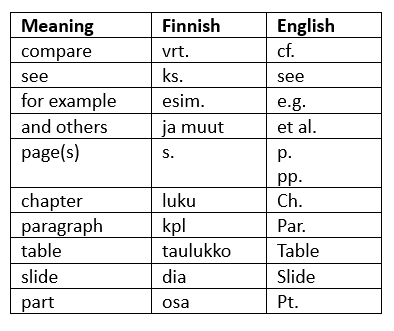
- If necessary, the nature of the citation can be clarified with the abbreviation cf. (compare), which emphasises that the source referred to addresses the topic from a different perspective than that of the author. The abbreviation e.g., when used together with the verb see, indicates that additional information or support for the author’s text can be found in the given sources. This can also be used to suggest that the reader should examine the topic more closely in another source or a different section of the text.
Citing different types of sources
Books, e-books, and articles
- At present, the bulk of source material is in digital format, even when it consists of literature. Visual and audiovisual source material is also being used more frequently in theses.
- When citing books, e-books, and articles, the same citation methods explained in the section "Using sources" are used.
- E-books that are subject to updates should be cited with both the original publication year and the year of the most recent update. This is illustrated in the following examples.
Text text text (Salvatore, 2015/2023, Chapter 6, Economies of Scale, Imperfect Competition, and International Trade).
Salvatore (2015/2023, Chapter 6, Economies of Scale, Imperfect Competition, and International Trade) states [– –].
Theses and dissertations
- Theses and dissertations are cited in the same way as published books.
Text text text (Pak, 2023, p. 43).
In their dissertation, Girgibo (2023) states that [– –].
- Doctoral dissertations are considered academic publications. It is advisable to consult one’s own thesis supervisor to determine whether it is acceptable to use lower-level theses, such as Master’s theses, as sources.
Official sources (statutes, decrees, and statistics)
- Up-to-date information on statutes of law is available from the Statute Book of Finland or the Finlex database. Finlex is a Finnish online database providing up-to-date legislative and other judicial information. It can be accessed here: https://www.finlex.fi/en/. When using law books, it is important to note that the information may be outdated.
- When citing a statute or decree, its full name and number should be provided:
According to the Study Leave Act (1287/2013) Section 13., text text text.
OR
Text text text (Study Leave Act (1287/2013, Section 13.).
- When citing the same statute again in the same text:
Text text text text (Study Leave Act, Section 16.).
- When citing several sections of law:
Text text text text (Study Leave Act, Section 9 a., Section 16.).
- Use the abbreviation CD when citing committee deliberations:
Text text text (CD 1988, 11 p. 25).
- When citing statistical sources, the citation should include the author (publisher), publication year, and page number:
Every other Finn follows at least one social networking site online (Statistics Finland, 2013, p. 13).
- The author of statistical sources is usually an institution, organisation or association.
Research material, standards, patents
- Cite research materials, standards, and patents in the following ways:
(Finnish Standards Association, 2017).
The Finnish Standards Association (2017) standard states [– –].
(Arrasvuori et al., 2019).
In the patent by Arrasvuori et al. (2019), [– –].
Online material
- Online material comprises a wide range of sources, from ministry reports to personal blogs. Extra care should be taken with online sources, and if needed, to ask for guidance from the thesis supervisor.
- When citing online materials, include the author, publication date, and pages numbers, if available. Instead of page numbers, the citation can include a chapter number or heading, slide number, video timestamp, or other similar clarification. The publication date is only included in the reference list, not in the in-text citation.
TV and film
- The director is usually cited as the author of a film or television production.
Emails, interviews and discussions
- Personal communication includes emails, unarchived discussion forum messages, personal interviews, phone conversations, and other similar forms of communication.
Text, text, text (J. Doe, personal communication, December 11, 2019).
- Personal communication is not included in the reference list.
- In publications aimed at professionals or a wider audience, web pages with restricted access, such as Moodle or a company intranet, are considered personal communication. However, in all papers and Bachelor’s and Master’s theses written at the University of Vaasa, these can be cited as online sources.
Compiling the reference list
- All sources cited in the work must appear in the reference list, and correspondingly, there must be a citation in the text for every source that is found in the reference list. The citation must match the beginning of the reference list entry.
- The reference list is placed at the end of the text, but before the appendices, if applicable.
- The line spacing of the reference list is 1.5, and no blank lines are left between entries.
- All sources (including, for example, data sources) are entered in alphabetical order in a single reference list.
- Publications by the same author are arranged chronologically, from the oldest to the newest.
- Publications by the same author are listed by time from the oldest to the most recent one.
- For each individual entry, any additional lines after the first line should be indented by 1.25 cm.
The elements of the reference list
- The reference list must include the following elements, in the given order and with the details required for the particular type of source in question.
- The first element is the author. The author is the writer, editor, director, photographer, etc. The reference list is alphabetised according to this element. If there are 20 or fewer authors, all authors are listed in the reference list, and an ampersand (&) is placed before the last author’s name. If there are 21 or more authors, the first 19 are listed, followed by a comma, a space, three dots, a space, and the final author.
- The second element is the date. This means the year of publication. This element specifies at least the year, and for online sources, the publication date should be given even more precisely. If no date can be found, such as for a website, the abbreviation n.d. is used.
- The third element is the title. This means the title of the book, article, blog post, image, etc.
- The fourth element is the origin of the source. This means the publisher, journal, edited volume, or website. If the name of the website is the same as the author, it does not need to be repeated. The DOI and hyperlink belong to this element. If a book or an article has a permanent identifier (DOI, URN), it should be used even when referencing a printed book. The permanent identifier is written in the reference list as a hyperlink (e.g. DOI https://doi.org/10.1007/978-3-658-15220-8_18 or URN http://urn.fi/URN:ISBN:978-952-476-861-0). If an online source has a permanent identifier, it is not necessary to add separate information indicating that it is an online source or the date it was retrieved. Instead, it can be referenced in the same way as printed material.
- A full stop follows each element, unless the element itself ends with a full stop, exclamation mark, or question mark. No full stop is added if the element itself ends with a full stop, for example, Surname, A. A. Similarly, no full stop is added after web addresses.
- The word processor can be allowed to break links, but they should not be manually broken so that they function correctly in the final document and meet accessibility requirements.
Reference list: missing information
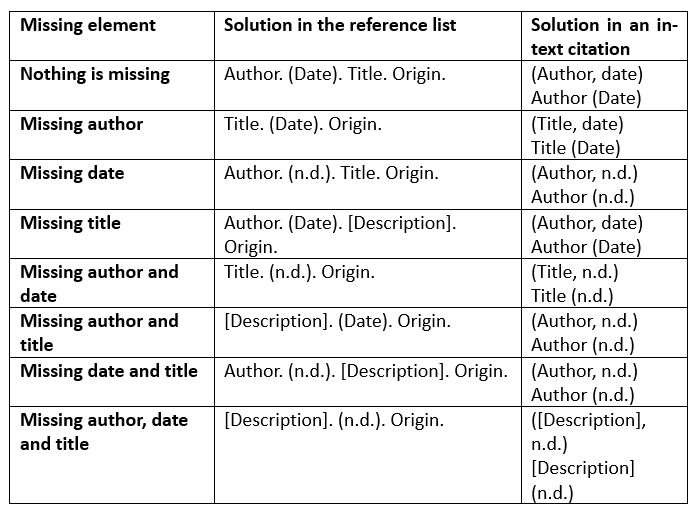
- In some cases, an element may be missing. The following table shows how the reference list entry or in-text citation should be constructed when a particular element is missing. Page numbers are always mentioned in citations when they are available.
Restricted access to the source
- If the material is restricted to a specific user group, such as company employees (company intranet) or course participants (Moodle), it is referenced as a regular webpage.
- However, since it is important for the reader to know about the restricted access, this should be indicated in the reference list entry with the note [restricted availability]. As previously stated, this referencing guideline applies only to coursework and theses written at the University of Vaasa.
- In the case of professional publications, such sources are treated as personal communication and excluded from the reference list.
Different types of sources in the reference list
Monographs
- A monograph is a study written by a single author or a group of authors on a specific, unified topic.
- It can be a printed book or an e-book, and is sometimes published in both formats.
- Printed and e-books are cited in the same way.
- If a permanent identifier, such as a DOI or URN, is included in the details of the printed book, it should be listed in the references as a hyperlink beginning with https://.
- If the e-book link does not lead directly to the book or if the name of the database is not useful to the reader, it should not be included in the reference list.
- The place of publication is not included.
- The details of the monograph are written in the reference list as follows (in these writing guidelines, reference list examples are separated from the body text with horizontal lines, for the purpose of clarity):
Surname, A. A. (Publication year). Title of the book (Edition). Publisher. https://doi.org/10.xxx
______________________________________________________________________
Kenny, D. (Ed.) (2022). Machine translation for everyone: Empowering users in the age of artificial intelligence. Language Science Press. Retrieved October 5, 2024, from https://langsci-press.org/catalog/book/342
Mohamed, S. (Ed.) (2024). Social media: Opportunities and risks. IntechOpen. https://doi.org/10.5772/intechopen.100650
McRobbie, A. (2016). Be creative: Making a living in the new culture industries. Polity. ISBN: 978-0-745-66195-7.
______________________________________________________________________
- Surnames with a prefix are usually placed in the reference list in alphabetical order according to the main surname, not the prefix. Prefixes are usually placed after the first name.

- However, different countries have varying practices for the alphabetical order of such names, so the spelling and citation practice should be checked separately, preferably from the author’s own information. Noble prefixes (von, de, af, etc.) are capitalised in the usual way at the beginning of a sentence.
Monograph: two or more works by the same author, published in the same year
- When referencing two or more works by the same author, published in the same year, list the sources alphabetically and use a lowercase letter (a, b, c) beside the publication year to distinguish between them. This also applies to articles.

Monograph: a chapter in an anthology
- An anthology is a work consisting of independent chapters written by different authors. In this case the reference is made to the author of the chapter.
Surname, A. A., & Surname, B. B. (Publication year). Title of the book chapter. In E. E. Editor (Ed.), Title of the book (pp. 1–123). Publisher. https://doi.org/10.xxx
______________________________________________________________________
Saleem, S. & Larimo, J. (2016). Hofstede Cultural Framework and Advertising Research: An assessment of the literature. In G. Christodoulides, A. Stathopoulou & M. Eisend (Eds.), Advances in Advertising Research (Vol. VII): Bridging the Gap between Advertising Academia and Practice (pp. 247–263). Gabler Verlag. https://doi.org/10.1007/978-3-658-15220-8_18
Monograph: the author is also the editor of the anthology
Surname, C. C. (Ed.). (Year). Title of the book. Publisher. https://doi.org/10.xxx
______________________________________________________________________
Huttunen, R., Kinnunen, M., Lemström, B., Hirvonen, P., & Kuuva, P. (Eds.). (2024). Finland’s integrated national energy and climate plan update. Ministry of Economic Affairs and Employment. Retrieved October 4, 2024, from https://julkaisut.valtioneuvosto.fi/handle/10024/165742
Articles
Surname, A. A. (Publication year). Title of the article. Name of the journal, Volume(Issue), 1–123. https://doi.org/10.xxx
______________________________________________________________________
Kazmi, S. A. Z., Naaranoja, M., & Kytölä, J. (2016). Integrating strategic thinking and transformational leadership for NPD idea support process. Procedia - Social and Behavioral Sciences, 229, 387–397. https://doi.org/10.1016/j.sbspro.2016.07
- If an article has a permanent identifier (DOI, URN), it should be used even when referencing a printed article. The title of the article is not italicised, but the name of the journal is italicised.
Surname, A. A. (Year, Month DD). Title of the article. Name of the newspaper or magazine, Volume(Issue), 1–123.
______________________________________________________________________
Bol, D. (2024, September 12). Double defeat for Swinney on school meals and peak fares. The Scotsman, 1, 4–5.
- If only a web address is available instead of a permanent identifier, extra care should be taken to reference accurately. In this case, the date when the webpage was accessed should also be included so that any possible updates made to the site since the time of access can be checked. The reference list entry should include the phrase Retrieved Month DD, YYYY, from.
Surname, A. A., & Surname, B. B. (Year, Month DD). Title of the article. Name of the newspaper or magazine, Volume(Issue), 1–123. https://hyperlink.address
______________________________________________________________________
Ahola, M., & Zafar, A. (2019, September 9). Merging and collaboration of educational institutes: New dimension of open innovation. LAMK Pro. Retrieved December 31, 2019, from http://www.lamkpub.fi/2019/09/09/merging-and-collaboration-of-educational-institutes-new-dimension-of-open-innovation/
- If referring to an article that has been published online before the journal’s print publication, the journal’s detailed information and page numbers may not yet be available, and the article may be labelled with phrases such as “online first publication”, “Advance online publication”, “In Press, Corrected Proof”, or “Ahead-of-print”. These are standardised to “Advance online publication”, and marked in the reference list as follows:
Klemola, A. (2019b). Small investors’ internet sentiment and return predictability. Review of Behavioral Finance. Advance online publication. https://doi.org/10.1108/RBF-02-2018-0019
Newspaper article
Surname, A. A. (Year, Month DD). Title of the newspaper article. Name of the newspaper, Volume(Issue), 1–123. https://hyperlink.address
______________________________________________________________________
Robson, D. (2023, September 17). “I couldn’t believe the data”: How thinking in a foreign language improves decision-making. The Guardian. Retrieved September 24, 2024, from https://www.theguardian.com/science/2023/sep/17/how-learning-thinking-in-a-foreign-language-improves-decision-making
Article: an article in an anthology
- A compilation is a work consisting of independent articles written by several different authors. In this case the reference is made to the author of the article.
Surname, A. A., & Surname, B. B. (Publication year). Title of the book chapter. In E. E. Editor (Ed.), Title of the book (pp. 1–123). Publisher. https://doi.org/10.xxx
______________________________________________________________________
Saleem, S., & Larimo, J. (2016). Hofstede cultural framework and advertising research: An assessment of the literature. In G. Christodoulides, A. Stathopoulou, & M. Eisend (Eds.), Advances in Advertising Research (Vol. VII): Bridging the Gap between Advertising Academia and Practice (pp. 247–263). Gabler Verlag. https://doi.org/10.1007/978-3-658-15220-8_18
Article: blog post
Surname, A. A. (Year, Month DD). Title of the blog post. Name of the blog. https://hyperlink.address
Ouellette, J. (2019, November 15). Physicists capture first footage of quantum knots unraveling in superfluid. Ars Technica. Retrieved December 10, 2020, from https://arstechnica.com/science/2019/11/study-you-can-tie-a-quantum-knot-in-a-superfluid-but-it-will-soon-untie-itself/
Theses and dissertations
- If a thesis does not have a permanent identifier, such as a URN or DOI, the phrase Retrieved Month, DD, YYYY, from is added before the hyperlink.
- Doctoral dissertations are considered academic publications. It is advisable to consult the thesis supervisor to determine whether it is acceptable to use lower-level theses, such as Master’s theses, as sources in the thesis.
Surname, A. A. (Publication year). Title of the thesis [Level of the thesis, Name of the university]. Name of the database. https://urn.fi/URN:xxx
______________________________________________________________________
Ittonen, K. (2009). Audit reports and stock markets [Doctoral dissertation, University of Vaasa]. Osuva. https://urn.fi/URN:ISBN:978-952-476-256-4
Pak, Y. (2023). What we talk about when we talk about entrepreneurship and stress: Essays on entrepreneurial stress [Doctoral dissertation, University of Vaasa]. Osuva. https://urn.fi/URN:ISBN:978-952-395-112-9
Reijonen, J. (2018). Decentralized machine learning for autonomous ships in distributed cloud environment [Master’s thesis, University of Vaasa]. Osuva. Retrieved December 31, 2019, from https://osuva.uwasa.fi/handle/10024/9493
Official sources
- The author can also be an organisation, institution, or association. If a source does not have a specific author, it is listed in the references either by the publisher or the title of the source. The format of entries in the reference list must correspond to how the source in given in in-text citations.
The Finnish national network in cross-border civil and commercial matters: Guide for the member. (2020). Ministry of Justice. http://urn.fi/URN:ISBN:978-952-259-916-2
Ministry of Justice. (2020). The Finnish national network in cross-border civil and commercial matters: Guide for the member. http://urn.fi/URN:ISBN:978-952-259-916-2
Merriam-Webster Dictionary. (2024). Opponent. Retrieved October 4, 2024, from https://www.merriam-webster.com/dictionary/opponent
Statistics
- If the publisher’s name is given in the in-text citation, the following details should be included in the reference list entry:
Organisation/Institution. (Publication year). Title of the statistic. Publisher. https://urn.fi/URN:xxx
______________________________________________________________________
Statistics Finland. (2024). Product innovations generated 16 per cent of enterprises’ turnover in 2022. Retrieved October 4, 2024, from https://stat.fi/en/publication/cln1gs0193pz00bw1j8osiu3r
______________________________________________________________________
Statutes and decrees
- If legal statutes or decrees are included in the reference list, the entry should contain the full title, the number, a slash, the year of issue, the name of the publisher, and where it was accessed.
______________________________________________________________________
Act on Preventing Money Laundering and Terrorist Financing 444/2017. Finlex. Retrieved October 5, 2024, from https://www.finlex.fi/en/laki/kaannokset/2017/en20170444
Study Leave Act 1287/2013. Finlex. Retrieved December 11, 2020, from https://finlex.fi/en/laki/kaannokset/1979/en19790273
______________________________________________________________________
- Normally, legal statutes are not included in the reference list. It is advisable to discuss field-specific practices with the thesis supervisor. The reference list entries for other official sources should match the in-text citation exactly.
Research materials, standards, and patents
Surname, A. A., & Surname, B. B. (Publication year). Title of the material (version) [Data set]. Publisher. https://urn.fi/URN:xxx
Arrasvuori, J., Eronen, A., Lehtiniemi, A., & Leppänen, J. (2019, September 10). Apparatus and method for associating images from two image streams (EP3550817A1·2019-10-09) [Data set]. Espacenet. https://worldwide.espacenet.com/patent/search/family/061912995/publication/EP3550817A1
Organisation/Community. (Publication year). Title of the standard (Version).
International Organization for Standardization. (2022). Information security, cybersecurity and privacy protection — Information security management systems — Requirements (ISO/IEC 27001:2022)
Online sources
- Online sources should be critically evaluated as regards reliability of content.
- Web addresses should not be manually hyphenated; this should be handled by the word processing software to ensure the hyperlink remains accessible in the final work.
- Note that for online sources, the title is italicised, but the name of the website is not.
Surname, A. A., & Surname, B. B. (Year, Month DD). Title of the article. Name of the website. https://hyperlink.address
Adams, A. (2019, October 8). Book and book chapter references: No location required. APA Style Blog. Retrieved December 17, 2019, from https://apastyle.apa.org/blog/publisher-locations-in-book-references
Surname, A. A., & Surname, B. B. (Year, Month DD). Title of the text. Name of the website. https://hyperlink.address
Browne, R. (2024, September 26). Google venture arm backs startup aiming to bring mixed reality to any car windshield or plane cockpit. CNBC. Retrieved October 5, 2024, from https://www.cnbc.com/2024/09/26/google-backs-distance-startup-bringing-mixed-reality-to-cars-planes.html#:~:text=Distance%20Technologies,%20a%20Finnish%20startup%20that%20aims%20to%20bring%20mixed-reality?msockid=0aa3b6d9d0ef6df83c91a53dd1c76c11
Organisation/Institution. (Publication year). Title of the text. Name of the website. https://hyperlink.address
U.S. Food and Drug Administration. (2024). FDA approves first nalmefene hydrochloride auto-injector to reverse opioid overdose. Retrieved October 5, 2024, from https://www.fda.gov/news-events/press-announcements/fda-approves-first-nalmefene-hydrochloride-auto-injector-reverse-opioid-overdose
Mantila, S. (2024). Grammar & exercises 1 [Self-study material]. Moodle [Restricted access]. Retrieved October 5, 2024, from https://learn.uwasa.fi/mod/h5pactivity/view.php?id=130494
@screenname. (Year, Month DD). Title of the text [Description of the media].Name of the website. https://hyperlink.address
Tritonia [@TritoniaLib]. (2020, January 22). #univaasa Access to Oxford University Press Journals now available! 368 journals in social sciences, law, science & mathematics, and more. [Tweet]. Twitter. Retrieved January 27, 2021, from https://twitter.com/TritoniaLib/status/1352581833884651521?s=20
TEDx Talks. (2017, December 13). Susanna Kultalahti: Messages from generation y [Video]. YouTube. Retrieved December 22, 2017, from https://youtube/hwhpw9nOPiM
Name of the channel. (Year, Month DD). The first 20 words of the post [Description of the media].Name of the website. https://hyperlink.address
University of Vaasa. (2024, October 4). University of Vaasa has been awarded €1.3M from the Research Council of Finland as part of the NSF-funded project [Post]. X. Retrieved October 5, 2024, from https://x.com/univaasa/status/1842168848289534185
TV and film
- In a thesis, sources such as films, songs, television and radio programmes, as well as images and videos published online, may be used.
- If multiple films or television programmes are the subject of analysis, a list of these materials should be included as an appendix to the thesis. The same applies to videos published on video-sharing platforms such as YouTube, if they are used as research material.
- The author of such sources is typically the director, but it can also be the producer, host, or the person who posted the material online.
- If a source accessed via a streaming service is available only for a limited time, no hyperlink is included in the reference list.
Director, D. D. (Publication year). Title of the film [Film]. Production company.
______________________________________________________________________
Forman, M. (Director). (1975). One flew over the cuckoo's nest [Film]. United Artists.
______________________________________________________________________
Director D. D. (Year, Month DD). Title of the episode (Season number, Episode number) [TV series episode]. In P. Producer (Executive Producer), Title of the series. https://hyperlink.address
___________________________________________________________________
Barnard, C. (Director) (2024, November 3). Tuulinen päivä [Windy day] (Season 2, Episode 1) [TV series episode]. In C. Barnard, J. Graham, J. Howell, J. McClellan, T. Ross, & H. Spencer (Executive Producers), Sherwood. https://areena.yle.fi/1-62140160
______________________________________________________________________
Director D. D. (Year, Month DD). Title of the episode (Season number, Episode number) [TV series episode]. In P. Producer (Executive Producer), Title of the series. Production company.
______________________________________________________________________
Chase, D. (Director) (2007, June 10). Made in America (Season 6, Episode 21) [TV series episode]. In D. Chase, B. Grey, I. S. Landress, M. Weiner, & T. Winter (Executive Producers), The Sopranos. HBO; Brillstein Entertainment Partners.
______________________________________________________________________
Poster, P. P. (Year, Month DD). Title of the video [Video]. Title of the web page. https://hyperlink.address
______________________________________________________________________
University of Vaasa. (2019, January 23). Univaasa – Agents of change [Video]. YouTube. Retrieved December 17, 2020, from https://youtu.be/VLO63lQ29Eo
______________________________________________________________________
Artificial intelligence
- Artificial intelligence (AI) is not considered a scientific source and should therefore not be cited as a source in academic research. However, AI may be used, for example, to generate ideas, draft text, check language and accuracy, and create or edit images, figures, tables, or code.
- The use of AI must be reported openly and clearly in the thesis. Guidelines for reporting the use of AI are provided in Appendix 1. If AI has not been used, this should be stated briefly.
- If AI has been used, the creator, company, or publisher of the AI model must be included in the reference list.
Creator/company/publisher of the model. (Publication year). Name of AI (Release date of the version) [Description]. https://hyperlink.address
______________________________________________________________________
OpenAI. (2023). ChatGPT (Mar 14 version) [Large language model]. Retrieved December 1, 2023, from https://chat.openai.com/chat
______________________________________________________________________
Emails, interviews, and discussions
- Personal communication includes emails, unarchived discussion forum messages, personal interviews, phone conversations, and other similar forms of communication. Personal communication is not included in the reference list.
- In professional publications and those intended for a wider audience, websites with restricted access, such as Moodle or a company intranet, are considered personal communication. However, in all papers and Bachelor’s and Master’s theses written at the University of Vaasa, these should be cited as online sources.
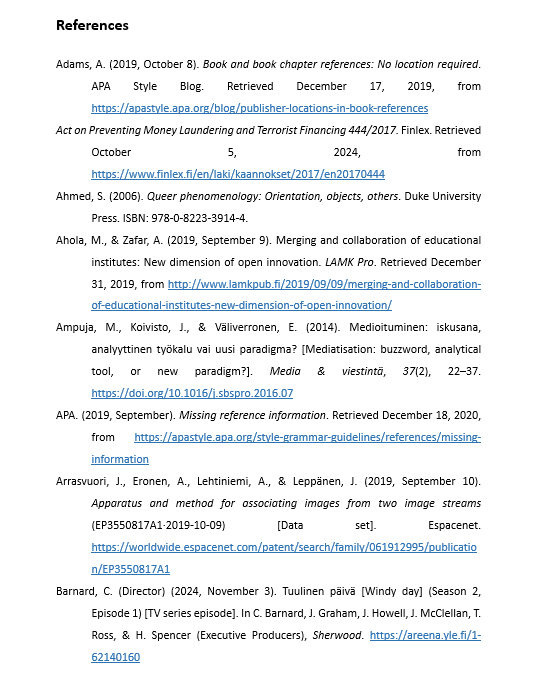
Example of a reference list
FAQ
Why do the University of Vaasa Writing Guidelines not follow APA style exactly?
The University of Vaasa Writing Guidelines are based on the 7th edition of the APA guidelines as regards referencing sources, but they are an adaptation of APA style. Therefore, the University’s own guidelines must be followed even where they differ from APA 7.
On the abstract page, there is a field titled Degree Programme. What should I enter in this field?
Enter the name of your degree programme. The correct field is Degree Programme, not Discipline.
In which language should the abstract be written?
If the thesis is written in English and you received your basic education in Finland, the abstract must be in Finnish or Swedish. If your basic education was in another language, the abstract may be written in English or another language, as agreed with your supervisor.
Should there be a blank line after a heading? The guidelines say there should be one, but the template does not always seem to follow this rule.
Yes. According to the Writing Guidelines, there should always be one blank line between a heading and the text that follows it. Follow the written guidelines if the formatting in the template appears to differ.
What methods of emphasis can I use in the text?
Bold and italics may be used according to your supervisor’s instructions, but bold is preferable for accessibility. Avoid underlining, and use all methods of emphasis sparingly and consistently; colour must not be the only means of conveying information.
My thesis contains many different images. Do they need to be categorised in some way?
Yes. Images and figures are numbered in separate series (e.g. Image 1, Figure 1) and listed separately after the contents table. If there are no more than three images, figures or tables, a separate list is not necessarily required.
How should examples be formatted?
Examples from the research material are numbered consecutively, use single line spacing and are indented 1.5 cm for the example number and 2.5 cm for the example text. They are not enclosed in quotation marks or italicised and must be referred to and explained in the text.
What is alt text?
Alternative text, or alt text, describes the essential information conveyed by a figure, image or table. It should provide the information that a reader would otherwise lose if the visual element could not be seen.
Why does my thesis need to be accessible, and how do I make it accessible?
Accessibility ensures that the document and its information can also be accessed by people using assistive technologies. Among other things, use the word processor’s styles for headings, provide alt text for figures, images and tables, and ensure that hyperlinks remain functional.
I cannot get the automatic list of figures or tables in the Word template to work. Is it a serious mistake to create the list manually?
The guidelines specify how lists of figures, images and tables should be formatted but do not require them to be generated automatically. A manually created list is therefore acceptable as long as it follows the required format and is accurate.
How do I cite the sources of a figure that I have adapted from several sources?
Clearly indicate that the figure has been adapted and cite all the original sources used. The figure should also make clear which elements are your own and which have been borrowed from the original sources.
What line spacing should I use in the reference list, and how should the entries be separated?
Use 1.5 line spacing and do not leave blank lines between reference list entries. Additional lines within an entry are indented by 1.25 cm.
What kind of information should be included in the appendices?
Appendices may include questionnaires or interview forms, correspondence related to data collection, examples of data, and figures or tables that are too large for the body text. The entire data set should never be included as an appendix.
What is the difference between a parenthetical citation and a narrative citation?
In a parenthetical citation, the author and other citation information appear in parentheses, e.g. (Saleem & Larimo, 2016, p. 248). In a narrative citation, the author is part of the sentence, e.g. Saleem and Larimo (2016, p. 248) state that…
When should I use the ampersand (&), and when should I use the word and in citations?
Use & between authors’ names in parenthetical citations and and when the authors’ names form part of the sentence in a narrative citation.
If a source has several authors, should I include all of them in the first in-text citation?
No. For three or more authors, use the first author’s surname followed by et al. from the first citation onwards. For two authors, always include both names.
What should I do if a source has no publication date?
Use the abbreviation n.d. (no date) both in the in-text citation and in the reference list.
What if two sources have the same author and were published in the same year?
Distinguish them using lowercase letters after the year, for example 2019a and 2019b. The same letters must be used in both the citations and the reference list.
How are direct quotations formatted?
Quotations of no more than three lines are enclosed in quotation marks. Longer quotations are indented 1.5 cm, use single line spacing and do not use quotation marks; all direct quotations must include a page number.
I am writing my Bachelor’s thesis in Finnish but want to include a direct quotation in English. Do I have to translate it into Finnish?
The Writing Guidelines do not provide a specific rule requiring direct quotations in another language to be translated. If you are unsure whether a translation is appropriate in your field or for your particular thesis, consult your supervisor.
How do I cite a secondary source, i.e. a source that I have found quoted in another source?
You should normally consult the original source. If you use a secondary source, indicate this with as cited in and include only the source you actually consulted in the reference list.
How do I cite an Act the first time and in subsequent citations?
The first citation gives the full name and number, for example Study Leave Act (1287/2013), Section 13. In subsequent citations, the number can be omitted, for example (Study Leave Act, Section 16).
What information should a reference list entry include?
The four main elements are author, date, title and source/origin, with the exact details depending on the type of source. Every source cited in the text must appear in the reference list, and every source in the reference list must be cited in the text.
Should reference list entries end with a full stop?
A full stop normally follows each element of a reference, but no full stop is added after a web address. A full stop is also not added if the element already ends in a full stop, question mark or exclamation mark.
How should I format a reference if the source does not have a permanent identifier such as a DOI or URN?
If only a web address is available, include the retrieval date using the format Retrieved Month DD, YYYY, from before the URL. However, if an article is also available in print, the web address is not included.
Should the reference list include the edition and place of publication of a book?
Include the edition when applicable, but do not include the place of publication.
How should the date be written in the reference list?
Give at least the publication year in parentheses; for online sources, give the publication date more precisely when available. If there is no date, use n.d.
When should the ISBN be included in the reference list?
The guidelines’ reference list examples include an ISBN for books where no DOI or URN is given. If a permanent identifier such as a DOI or URN is available, use that as a hyperlink.
Some articles do not have a DOI or URN, their links do not work, or they are only accessible with a University of Vaasa user ID and password. How should I include these sources in the reference list?
If there is no permanent identifier and the article is available in print, omit the web address. For online sources without a permanent identifier, give the URL and retrieval date; material with restricted access, such as Moodle content, should additionally be identified as having restricted access.
Should data sources be listed separately?
No. All sources, including data sources, are included alphabetically in a single reference list rather than in a separate list.
How should statutes and decrees be included in the reference list?
Statutes are normally not included in the reference list; field-specific practices should be discussed with the supervisor. If they are included, give the full title, number/year, publisher and retrieval information, e.g. Study Leave Act 1287/2013. Finlex. Retrieved … from...
Latest updates
Updates to the Writing Guidelines Word document, 11 August 2026
- Information has been added stating that the use of artificial intelligence must be reported openly and clearly (see Section 4.8). The reporting guidelines have been added as Appendix 1.
Updates to the Writing Guidelines Word document, 22 June 2026
- The instructions on how to cite a secondary source have been clarified.
Updates to the Writing Guidelines Word document, 27 June 2025
- It has been clarified that the major (previously subject) should be stated on the title page.
- It has been clarified that the degree programme and major (previously subject) should be stated in the abstract.
Updates to the Writing Guidelines Word document, 19 September 2024
- It has been clarified that the University of Vaasa Writing Guidelines are to be followed in theses written in both Finnish and English.
- It has been clarified that the University of Vaasa Writing Guidelines apply APA 7 style to citations and references. In other words, citations and references do not follow APA style exactly; rather, the University’s guidelines are an adaptation of APA 7 style.
Updates to the Writing Guidelines Word document, 10 June 2024
- The language requirements for the abstract have been clarified: If the thesis is written in English, the abstract must be written in the author’s language of school education, either Finnish or Swedish. If the author’s language of school education is a language other than Finnish or Swedish, the abstract may be written in English or in another language agreed upon with the supervisor.
Updates to the Writing Guidelines Word document, 6 March 2024
- Section 4.8, Artificial Intelligence (p. 49), has been added to the Writing Guidelines. It explains how artificial intelligence should be included in the reference list when it has been used, for example, to create or edit an image, figure or table.
- Information has been added stating that if an image, figure (p. 15), table (p. 16) or code (p. 20) has been created or edited using artificial intelligence, the prompt used and information about the use of AI must be included in the figure caption, table caption or explanatory text. The model to be followed can be found on page 15 of the Writing Guidelines Word document.
- The Writing Guidelines have been amended so that information concerning restricted availability is written in lower case as [rajattu pääsy] or, in English-language texts, [restricted availability] (p. 39).
- The reference list in the Writing Guidelines has been revised to conform to APA style. In titles of sources, such as article titles, words are written with lower-case initial letters even if they are capitalised in the original source.
Updates to the Writing Guidelines Word document, 28 April 2023
- Information has been added stating that the articles a, an and the are disregarded when alphabetising the reference list. Sources are alphabetised according to the first significant word (p. 37).
Information has been added stating that, in the reference list, the journal title, rather than the article title, is italicised (p. 41).