
What Does Good Validation Really Mean?
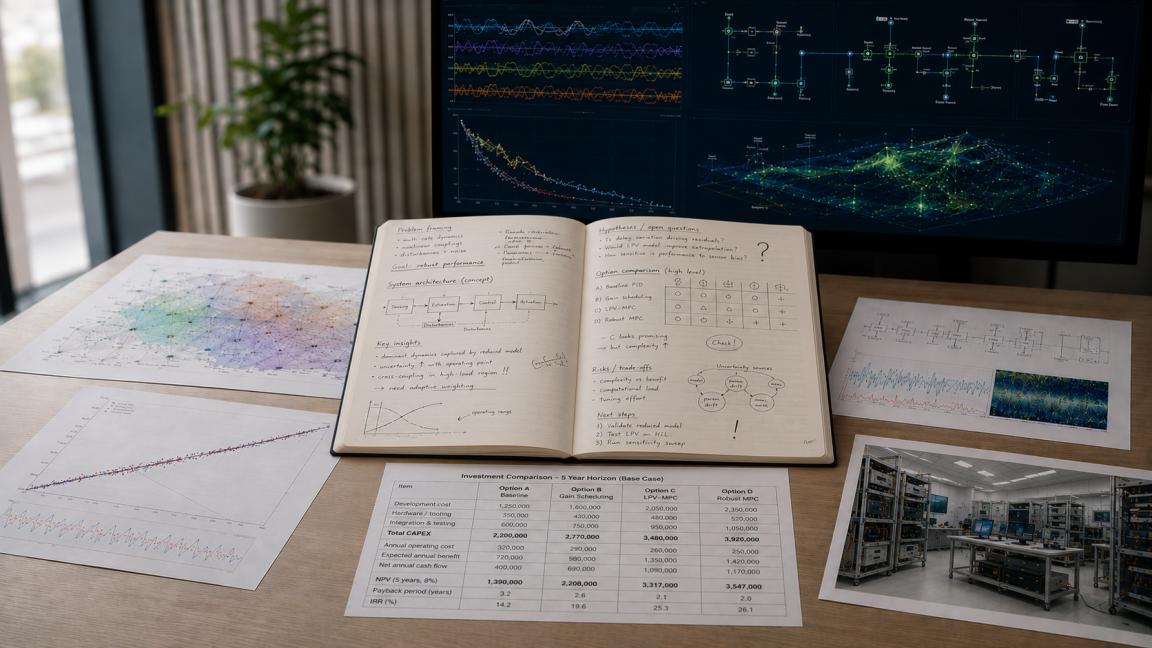


The more I have worked with validation, the less I think it is about testing. Today, I see it as something much more important: enabling sound decision-making.
In the energy sector, we talk constantly about validation. We validate solutions. We validate models. We validate technologies.
Lately, however, I have found myself returning to a simple question: What do we actually mean when we say that something has been validated?
Do we simply mean that a single test was successful? Or do we mean that we have gained enough confidence to trust a solution even when the real world refuses to behave exactly as expected?
Trust Is Not Built by a Single Experiment
We sometimes think that the defining moment for a new technology is the day it works for the first time.
In reality, a far more interesting question is this: When are we willing to integrate it into a real energy system? At that point, a single successful test is no longer enough.
We need to understand how it behaves under different operating conditions, how it responds to unexpected events, and how it interacts with the many other parts of an increasingly complex energy system.
Technical functionality is only the beginning. Equally important is understanding what deploying the solution means – not only for one's own organization and business, but also for the many other stakeholders across the energy system.
Validation as a Decision-Making Tool
Validation is often described as a process for proving that a solution works.
I see it differently. The purpose of validation is not to prove that a solution works, but to generate sufficient trustworthy evidence to support well-informed decisions.
The goal of good validation is not to eliminate uncertainty, but to reduce it enough that we can make well-informed decisions. At the same time, it helps us understand risk. Good validation does not tell us that all risks have disappeared, but that we understand them well enough to move forward.
The question is therefore no longer simply whether the technology works. The real question is whether we have gained enough understanding to make the next decision.
A Chain of Learning
Validation is often presented as a linear process.
First, scenarios are developed. Then models are built, optimization is performed, and simulations are carried out. Devices are tested in Hardware-in-the-Loop environments, followed by physical testing, and finally by pilot projects and deployment.
Written as a project plan, this sequence can easily resemble nothing more than a checklist. To me, however, it represents something much more interesting.
Each stage answers a different question.
Scenarios ask: What might the future look like?
Optimization asks: Which solution could perform best?
Simulation asks: How will the system behave?
Hardware-in-the-Loop asks: Do the models and the real technology work together?
Physical testing asks: Does the solution perform as expected in real equipment and operating conditions?
Pilots ask: Will it also work in the real world?
Every stage produces new knowledge. Every stage reduces uncertainty a little further. No single stage provides all the answers, but together they build a sufficiently strong foundation for the next decision.
Perhaps that is what good validation truly is.
When Failure Is Actually Success
This may be the most difficult aspect of validation to embrace.
The purpose of good validation is not to demonstrate that everything works perfectly. It is to generate trustworthy evidence about under what conditions, in which environments, and within which limitations a solution can be trusted.
Its purpose is to reveal where something does not yet work. If a simulation uncovers a problem, that is good news. If a Hardware-in-the-Loop experiment exposes a weakness at an interface, that is good news as well. If a pilot demonstrates unexpected behavior, we have learned something that could have been far more costly had it first appeared in a live electricity network.
Perhaps the greatest success of validation is discovering problems while they are still manageable or efficient to correct.
Why This Matters Right Now?
The energy system used to evolve relatively slowly. Technologies were introduced one at a time.
Today, electric vehicles, solar generation, battery storage, data centers, flexibility markets, artificial intelligence, cybersecurity, and increasingly sophisticated software are all being integrated simultaneously into the same system.
Whether an individual technology functions is no longer the most important question. What matters is whether everything works together.
That is why validation itself must evolve.
There Is No Perfect Certainty – Only Greater Confidence
Perhaps the most fascinating aspect of the energy transition is that the future can never be fully validated.
The world continues to change. Technologies evolve. Markets shift. People change their behavior.
Complete certainty will never exist.
But we can build deeper understanding. We can reduce uncertainty. We can make decisions based on stronger evidence than before.
Perhaps good validation is not a process that ends with an "Approved" stamp. It is a continuous process of learning – a journey toward sufficient understanding on which good decisions can be built.
And perhaps that is precisely why it has become one of the most important success factors of the energy transition.