
Feel the pulse – Arts-Based Approaches at NordiCHI 2026
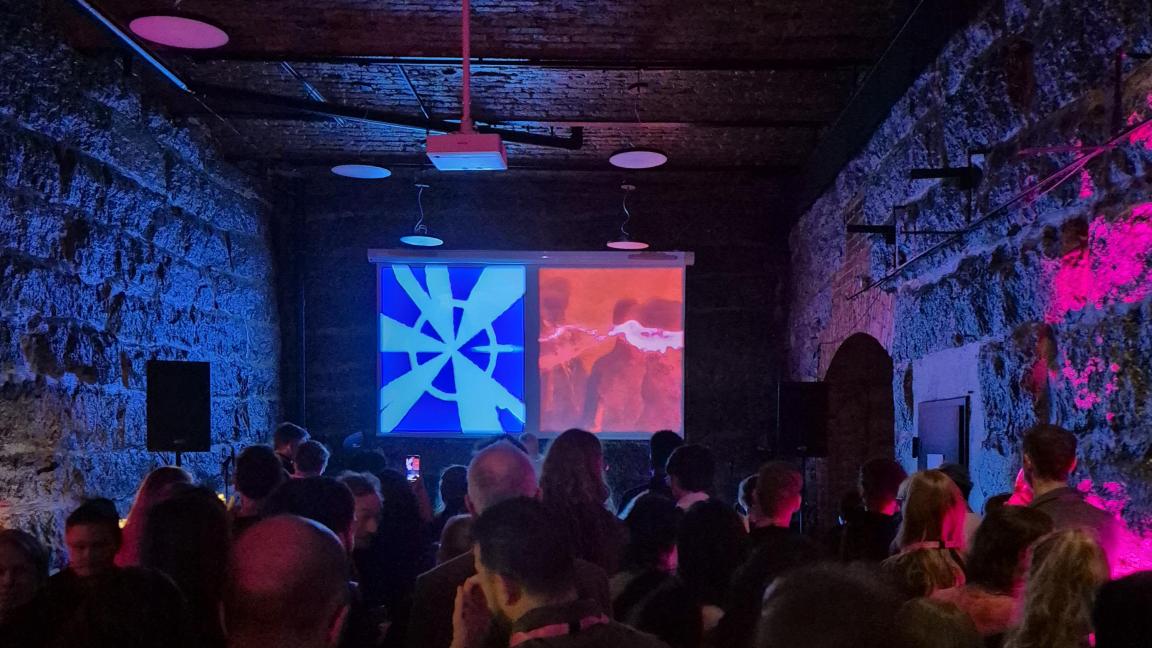
NordiCHI is one of the main human-computer interaction (HCI) conferences in the world, and the largest in the Nordic region. Held biannually, the conference attracts scholars and practitioners who focus on a range of human-centered issues and areas pertaining to the information technology design that we live by, and will live by. One key aspect of HCI being communication – communication in human-to-technology interaction, and communication between humans (one-to-one, one-to-many, and many-to-one, as seen in data driven systems).
This was the first time this track has been featured at any NordiCHI conference, and here we emphasise its (and art’s) importance as a methodological vehicle for transdisciplinary research, knowledge development and crucially communication. Artistic expression and exploration - aka arts-based research – communicates the non-linguistic and affords understanding through experience.
Beyond words
Art has the power to transcend language. It simultaneously expresses complex phenomena through experience, while challenging people to intellectually and emotionally engage in aspects of our everyday existence that we, perhaps, would not ever stop to think about. Art is a cultural manifestation, personal journey, scientific inquiry and vehicle for technological development. Art, in its many forms, is the landscape of activity in human life that is truly, distinctly human – by act and intention, even if expression is highly debated. Subjectivity demonstrating objectivity, and objectivity leading to subjectivity. Both components are necessary in order to simultaneously understand the world, and to master it. Therefore, in a techno-social world that is radically transforming through the rapid evolution of artificial intelligence (AI), opportunities, spaces and events that enable more deconstructive approaches and methodologies are much needed in the field of human-computer interaction (HCI). Moreover, from a temporal perspective artistic methods and practice tie the past with the future in ways that are not possible through more commercially oriented technology practice. Art enables an uncomfortable freedom, that while safely disconnected from the phenomena to which it inquires and comments, is firmly engrained within its fibres.
Arts-based approaches, stemming from traditions in arts-based research – contemporary art practice as a vehicle for research, art techniques and artistic inquiry as methodological pathways for research, and artistic expressions to convey scientific results – should be seen as a crucial next step for HCI gatherings globally. Arts-based approaches help us make sense of HCI in a world in flux. Arts-based approaches allow us as scholars and practitioners to critically reflect on our own roles, while probing deeper into the life-scapes of ‘others’. These methodological palettes and modes of communication, allow us to understand and expose underlying dynamics, biases and impacts on life and its systems.
This year’s NordiCHI 2026 with the theme, Pulse – exploring the energy that drives us! was the first to host an Arts-Based Approaches track. To put things bluntly, the idea stemmed from current global conditions. We are in many states of many crises. Neither design, nor business, nor what we now think of as science (framework making, theory building, publications and citation games), are proving to serve as solutions for the state of wicked problems we have now arrived at. Not only do we need solutions for driving ahead commercially, but we desperately need certain forms of resolution to contemplate our (and our planet’s) future and existence. We cannot solve problems, without understanding the problems. Often the understanding of the problems and their nature are the problems to begin with. Art helps us somehow understand phenomena in ways that are distinct from normative understandings. Art separates us from our own perspectives, jolting us into forms of awareness about normativities, while leveraging our subjectivity in a way that provides us freedom to consider phenomena from its various viewpoints. Both our presentation track and exhibition, featured at the conference dinner, hosted at the Catacombs, Wasa Innovation Center, achieved this on several levels.
Competition to this pioneering track was extremely competitive with only an 18% acceptance rate. The submissions underwent a rigorous review process. Each submission was first screened by the track co-chairs (Rebekah Rousi, Johanna Silvennoinen, and Anne Scott Wilson) reviewed by two expert peer-reviewers and then decided upon within a final panel discussion and evaluation based on scores obtained during the reviews, exhibition feasibility and quality.
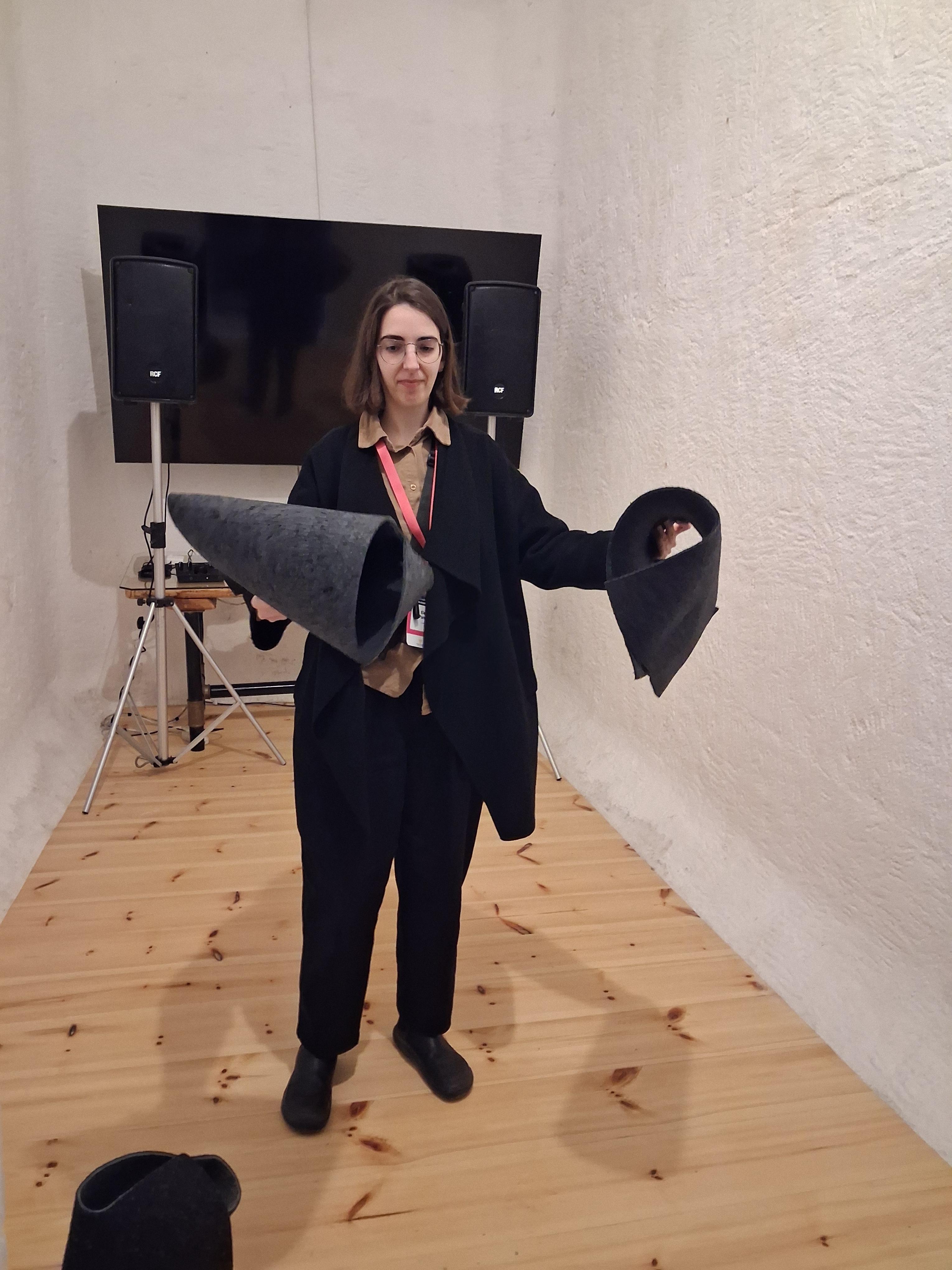
Schima – Morphe – Ichos by Eleni-Ira Panourgia and Martin Parker, made us – the audience – aware of the different sound frequencies around and between us. Projected by physical manifestations of felt soft sculptures, the audience was invited to participate in a responsive performance of playing with the soft forms to generate and transform sound. We were invited to adjust movement, in anticipation of how the sound would behave in relation to our mobile somatic relationship to the objects. The objects literally translated energy – the theme of the conference.
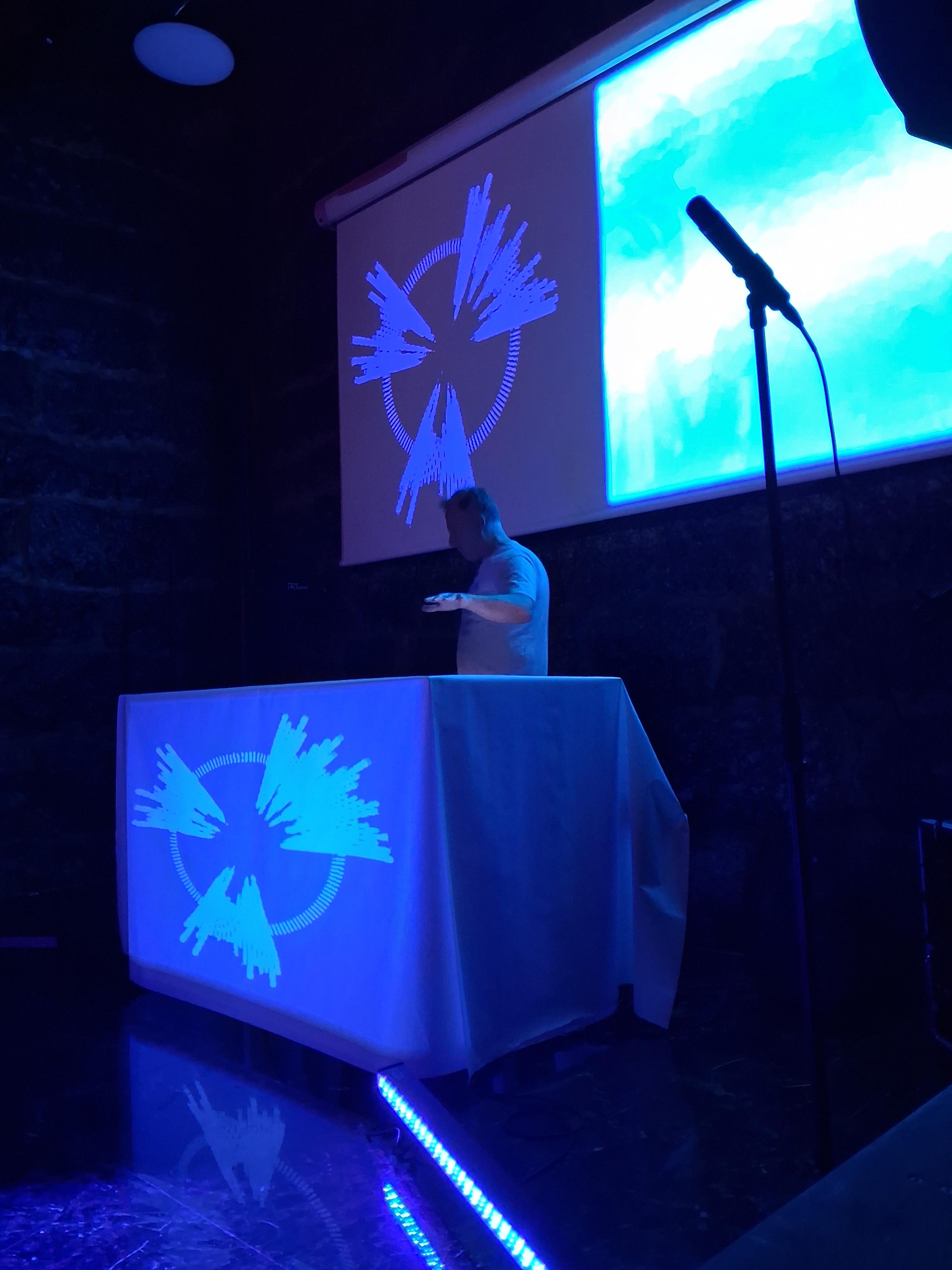
Similarly, Steve Gibson’s VRitual AV transformed us to a faraway space of rhythm and lights in which Steve and his performance were parts of a morphing apparatus that demonstrates how, through gesture interfaces, people not only can operate pervasive interactive technology, but become a part of it. As the artist says in his own words, the computer itself disappears into a relatively small “spatial footprint”, while the cultural expression of what it enables in the ambience of our space becomes pronounced. Once again, energy plays a central role through its ability to emotionally hypnotise and emotionally activate those present.
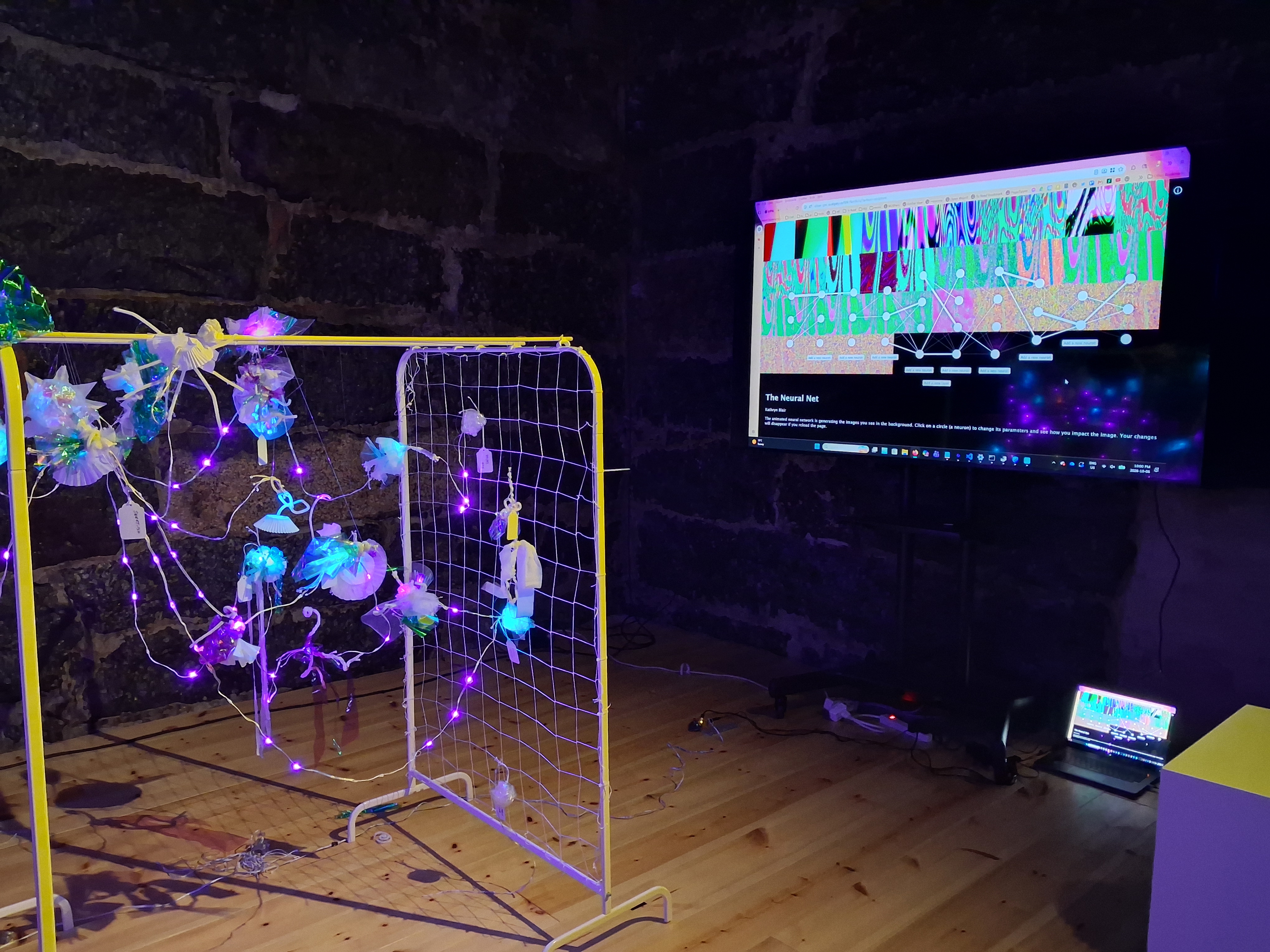
Kathryn Blair, Pil Hansen, and Lora Oehlberg’s The Neural Network brings the nodes of the architecture that powers large language model learning into the environment, where the audience is invited to contribute to the permanent network of neurons by creating their own soft sculptures that are physically attached to the piece. These contributions impact the virtual (neural) permanently, while the social entanglements inherent in the piece – the interactions between audience and artist, and audience with each other – also form biological neurological transformations. The audience is encouraged to consider how these relations materialise in everyday practices of human-computer interaction.
Charlotte Triebus and Christian Geiger’s presentation on Cosmic Noise, forced us to critically reflect on specific representations of the body, its functions and how we understand them from social performative perspectives. Their work that operationalises dance to portray aspects that often are peripherised such as salivating. At the heart of this work is the Other “a movement unit that is discrete enough to enter a protocol while carrying tacit and situated fragments of world-knowledge in its form, rhythm, and embodied provenance” (Triebus & Geiger, 2026). The choreographed movement units function as communication vehicles in situations where there is no common language with unknown entities.
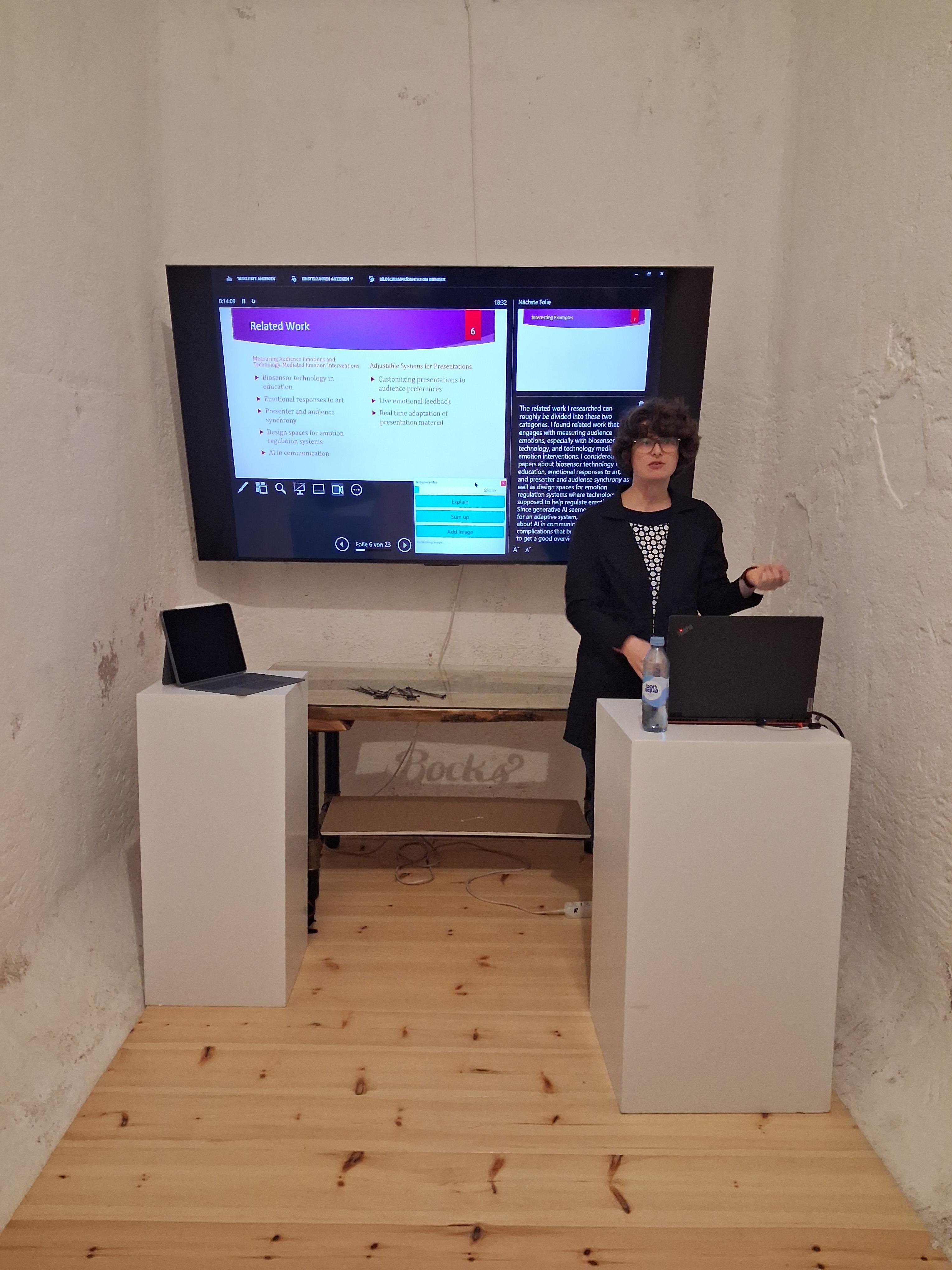
Nadine Jachmann’s Stress as Input demonstrates how it is possible to designed human-power point interaction using emotions and stress as input mechanisms. Jachmann transformed the traditional presentation format into a demonstrative, and somewhat uncomfortable, performance of nerves and anticipation. The audience was with her as the devices took their time to respond. We followed her progress as her pulse moved through the roof and back, and viewing the crazy entanglements unfolding on the stress-responsive power point slides, we wanted nothing more than to grab a whiteboard marker and join in by drawing on the screen. Her piece (the performance at NordiCHI) and confined encounter in a white cell (not padded) at the Wasa Innovation Center Catacombs were somewhat liberating – we can be honest about the anxiety public speaking and teaching causes, we do not have to like how the tech behaves, and it does not have to like how we behave. The meaning is found in the interaction between performance and sense-making.
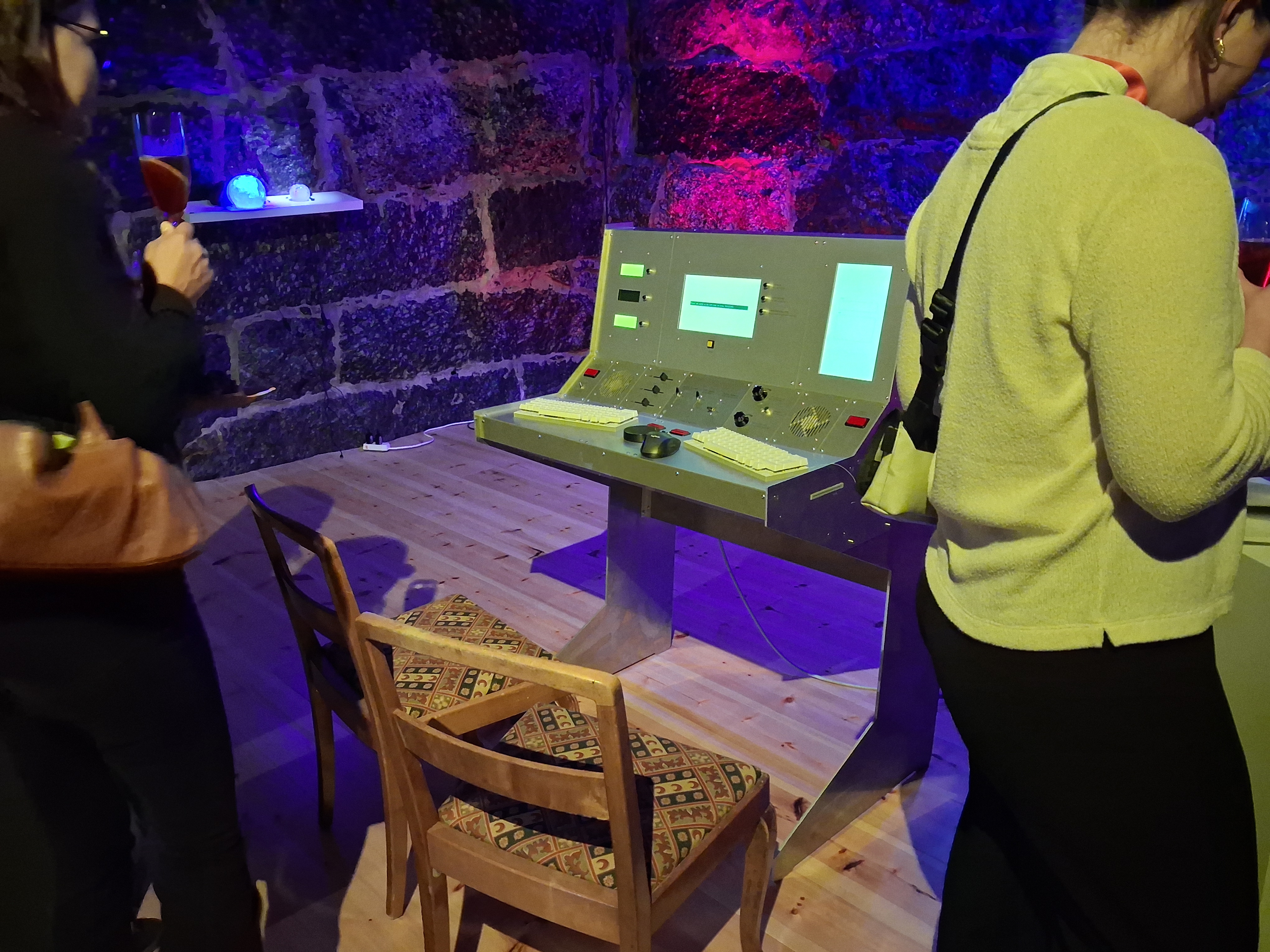
Eugénie Desmedt, Paul Kloker, Márton Zalka, Christine Haupt, Jonas Martschin and Martina Mara’s machine The Syntactic Synthesizer is a wonderful example of what a multidisciplinary team can do when embodying artificial intelligence with that personal twist. Designed as a writing instrument, the Synthesizer took us back to imaginaries of AI from the 60s (think Buck Rogers, Lost in Space, maybe even Star Trek if you watched it 😉). Here, the machine becomes a boundary object for audiences to interface with large language models and explore their parameters by for example pressing buttons and adjusting sliders. By mixing and matching the machine output, the audience can remix and their own poems on the machine.
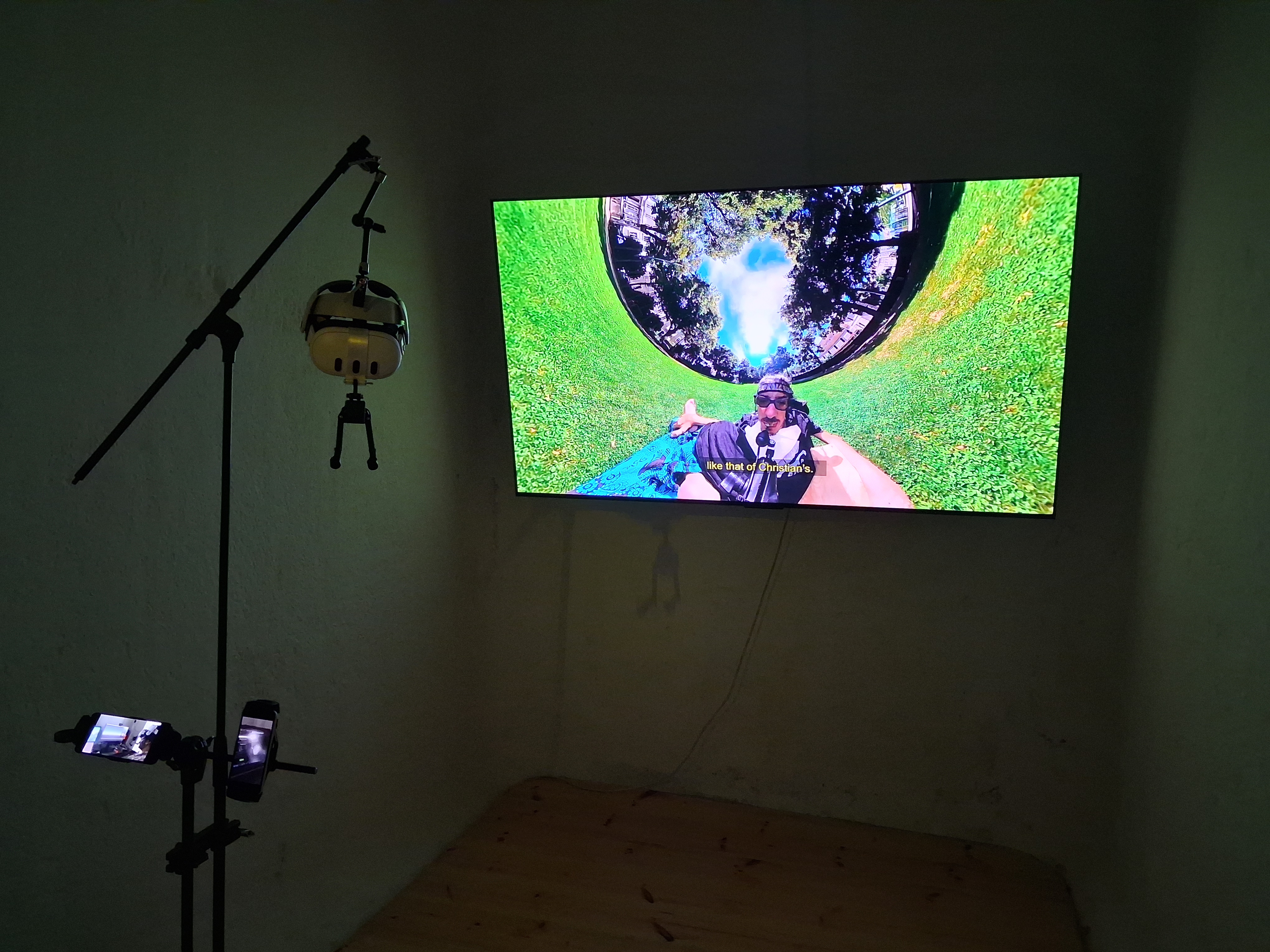
Finally, Puneet Jain left us seriously considering our own position as socially and culturally aware human-computer interaction scholars and practitioners, within the dynamics of designing for accessibility. As Jain mentioned in his presentation, he had entered into a relationship with two artist activists, thinking that as an engineer, he had the potential to transform their lives, when in the end, it was his life that was most transformed. You see, similarly to Charlotte and colleagues’ considerations for the other, as designers and academics, we constantly willingly or not, enter into patterns of assumptions that suggest the passive and helpless role of the people we design for rather than truly with. Through taking us into the lives of collaborators, Eric and Christian, “Have you ever been in a close encounter with a disabled body?” serves to reveal not just a lack of understanding, but a lack of listening and observing that designers, developers and scholars habitually fall into. The people we feel we can help are experts who know what they need and more pertinently what they want. This piece repositions able-bodied audiences (and the artist) as the ones who are dis-abled – even with seemingly functioning ears and eyes, can we really hear or see? We need the assistance to perceive the wealth of life that cognitive-sensory diversity affords human experience.
This Arts-Based Approaches presentation track and exhibition were the first of their kind. Based on our own experiences as co-chairs, and feedback received from the audiences, the track enables conference participants experiential encounters with creative HCI. Moreover, the track goes beyond art and creativity to truly highlight and explore current topics in HCI in disruptive ways, in ways that only art can. We would also like to take this opportunity to acknowledge the fact that this track would not have happened without the support of the NordiCHI 2026 General Co-Chairs Laura Havinen and Susanne Hägglund. Also, the incredible support and expertise offered to us by our expert panel consisting of Ylva Fernaeus, Aska Mayer, Jurgis Peters, Johan Bäckman, and Dean Golja, enabled the selection of an ensemble that not only demonstrated what can be done when combined artistic thought to HCI, but how careful selection leads to a profound composition of people, topics, and experiential learning that will last a lifetime.
As we navigate a techno-social world that is constantly transforming, and dare we say it, destabilising through an unwieldy and uncontrolled experiment – i.e., AI in its many forms, currently mainly LLMs - we need fresh, novel and unconventional ways to question, interpret, and making sense of the systems we create, inhabit, and that in many ways already govern our lives. Within HCI, this calls for spaces, encounters, and events that embrace more reflective, reflexive, exploratory, critical, and deconstructive approaches to research, practice and science communication. Arts-based approaches offer precisely this potential.
Arts-based approaches are not simply an alternative way of doing HCI.
Rather, they are an invitation to re-imagine the HCI-scape and seriously probe the pathways of which our future may become. They help us make sense of a world in flux, challenge our assumptions, and reflect critically on our own roles as researchers, designers, and practitioners. Through diverse methodological approaches and modes of expression, art can help reveal the underlying dynamics, biases, and consequences that shape our technologies, lives and ecologies entangled with them.
Ultimately, as AI continues to reshape the boundaries between the human, the technological, and the more-than-human, we need more than tools to build and evaluate systems. We need ways to question their meaning, explore their ambiguities, narrate, and imagine alternatives. Art, in its many forms, enables just that. It is time to make space for artistic inquiry not at the margins of HCI, but as an integral part of how we understand, critique, and shape our technological futures. Moreover, art is one of the most primitive and embedded forms of communication within human life, whether it be cave paintings, technical drawings, music, drama or interactive AI-driven media artworks, its methods and its forms bridge space and time between persons and peoples. It must not be forgotten that the arts are the arenas in which communication, cultural paradigms, and civic participation manifest is a meaningful and powerful way – beyond the borders of their disciplines.
Author Bios and Contact

Rebekah Rousi is a Professor of Communication and Digital Economy at the University of Vaasa, and Adjunct Professor of Cognitive Science that the University of Jyväskylä. Rousi holds a PhD in Cognitive Science, Master of Arts in Nordic Arts and Cultural Studies (Digital Culture), and Bachelor of Arts with First Class Honours in Visual Art. Rousi is a trained printmaker and practicing performance artist, with experience in exhibition curation and organisation. Rousi’s research interests include: embodied emotions, ethics, human-robot and human-AI interaction, privacy, trust, theology, posthumanism, and design (interaction design, design history and design business).
Johanna Silvennoinen is a Senior Lecturer of Cognitive Science at University of Jyväskylä, Finland with a background in arts and design. Her research focuses on cognitive and affective processes in humans interacting with technological artefacts, especially on the predictability of experience design, aesthetics, deceptive design, and human-AI co-creation.
Anne Scott Wilson is an artist-researcher and Senior Lecturer in the School of Communication and Creative Arts at Deakin University, Melbourne. Her practice-based research explores embodied interaction and how people and machines perceive each other. Drawing on her early training as a dancer, she makes interactive installations using motion capture, real-time game engines, custom software, drones and AI, often working with dancers. She recently curated The Familiar Unknown: Art in the Time of AI, which places pinhole photography and printmaking alongside AI-driven work to ask where artists hand control to systems and where they take it back. She holds a PhD in Fine Art from Monash University. Her chapter “A Ghost in the Machine” appears in Human Rights in the Age of Drones (Palgrave Macmillan, 2026).
For more information about the featured arts-based projects, please check out the Extended Abstracts:
Blair, K., Hansen, P., & Oehlberg, L. (2026, October). The Neural Network: A Participatory Artwork Creating a Collaborative Neural Network. In Adjunct Proceedings of the 14th Nordic Conference on Human-Computer Interaction (pp. 1-6). https://doi.org/10.1145/3821402.3830173
Desmedt, E., Kloker, P., Zalka, M., Haupt, C., Martschin, J., & Mara, M. (2026, October). The Syntactic Synthesizer: An Instrumental Interface for Semantic Remixing with a Large Language Model. In Adjunct Proceedings of the 14th Nordic Conference on Human-Computer Interaction (pp. 1-5). https://doi.org/10.1145/3821402.3830177
Gibson, S. (2026, October). VRitual AV: Tactile Micro Interface. Embodied Energy in Gestural Audio-Visual Performance. In Adjunct Proceedings of the 14th Nordic Conference on Human-Computer Interaction (pp. 1-6). https://doi.org/10.1145/3821402.3830171
Jachmann, N. (2026, October). Stress as Input: A Lecture Performance with Context-Adaptive Slides. In Adjunct Proceedings of the 14th Nordic Conference on Human-Computer Interaction (pp. 1-3). https://doi.org/10.1145/3821402.3830172
Jain, P. (2026, October). Disability Differently: Pulsing the Energy for a Radical Allyship in HCI. In Adjunct Proceedings of the 14th Nordic Conference on Human-Computer Interaction (pp. 1-5). https://doi.org/10.1145/3821402.3830176
Panourgia, E. I., & Parker, M. (2026, October). Schima–Morphe–Ichos: Performing across Sound, Sculpture and Movement. In Adjunct Proceedings of the 14th Nordic Conference on Human-Computer Interaction (pp. 1-4). https://doi.org/10.1145/3821402.3830174
Triebus, C., & Geiger, C. (2026, October). Embodied Transmissions for an Unknown Receiver: Cosmic Noise as a Choreographic First-Contact Protocol. In Adjunct Proceedings of the 14th Nordic Conference on Human-Computer Interaction (pp. 1-4). https://doi.org/10.1145/3821402.3830175